Lame Adventure 241: Goodbye New York Film Festival 2011!

The final two films Milton and I saw together at this year’s New York Film Festival were excellent documentaries, Vito and Pina.
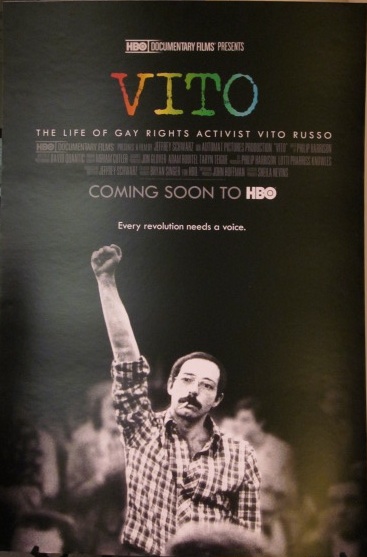
Vito, directed by Jeffrey Schwarz, is about the late gay rights activist and film historian/critic, Vito Russo.  Vito wrote the ultimate history book about gays and lesbians on film, The Celluloid Closet.  His book was also made into a fascinating documentary in 1996; required viewing for anyone interested in this aspect of film culture.  Schwarz pieces together Vito’s life story with painstakingly researched archival footage intercut with interviews Vito gave and recollections from those that knew him best, his friends and family.

Vito’s family, all highly opinionated but clearly very loving Italian Americans were resigned to the reality that Vito was different, but they were also very ahead of their time in accepting him years before Stonewall.  This strong family foundation undoubtedly contributed to his confidence as a proud gay man determined to make an impact.  Vito knew that being gay was as natural as being straight and he was going to prove it by being honest about who he was.  This included his practice of Judyism, his devotion to Judy Garland.

His early activism got underway post-Stonewall, during a difficult time when there was deep division in the ranks of gay leadership.  Vito was very accepting of all gay people including drag queens and lesbians, an unpopular stand in the early Seventies.  Following a gay pride celebration in New York in 1973 where the crowd was particularly unruly, he switched gears and focused on writing and the daunting mission of researching The Celluloid Closet.

In the early Eighties, in response to the AIDS crisis, a crisis that had a unifying effect on the LGBT community, Vito again took action fueled by the homophobic Reagan administration’s deeply unsympathetic response to the impact of this deadly disease.  Vito’s relentless AIDS activism was integral in forcing the LGBT community to realize that if they didn’t take action, cold-hearted right wing politicians would continue to ignore the severity of this disease that they foolishly assumed was just a gay plague.  Therefore, they denied funding research that could have led to the development of a cure or contain the epidemic.  Vito was outraged as he watched friends as well as his companion, Jeffrey Sevcik, die far too young from this disease.  When Vito was diagnosed with AIDS in 1985, his mother wanted him to move into her house in New Jersey so that she could nurse him.  His cousin recalled that although Vito loved his mother dearly, “He would rather die in New York than live in New Jersey.”

Overall, this poignant documentary is as much about Vito the man as it is also a history lesson about the gay rights movement and how gays and lesbians were depicted on film.  During the Q&A Schwarz said that his goal is to have Vito screened in high schools throughout the country so that today’s youth can be educated about gay history.  Frankly, I think that everyone young, not so young, gay, straight or undeclared should see this entertaining history lesson about this charismatic force.  HBO will screen Vito in June 2012.

Milton the Paparazzo iPhone shot of Lou Reed standing outside Alice Tully Hall before entering Pina screening.
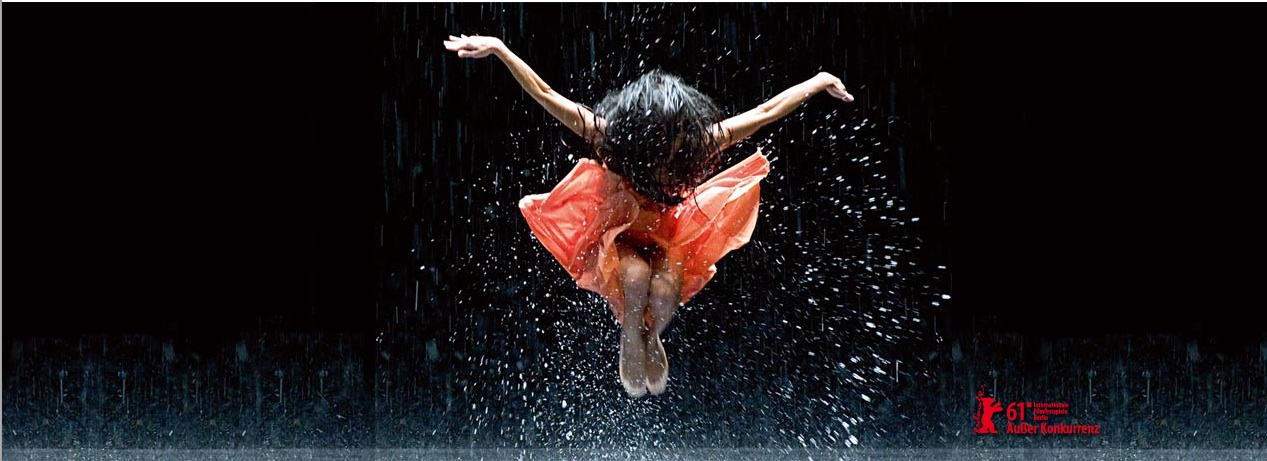
Pina

Milton thinks and I agree that the documentary, Pina, about the modern dance choreographer, Pina Bausch, directed by Wim Wenders, is possibly the first film shot in 3D where 3D has enhanced the storytelling.  A documentary about dance shot in 3D now seems like a no-brainer, but it took Wenders almost twenty years to figure that out.  He and Pina had been discussing collaborating on this venture for decades, but Wenders was reluctant to take on the project because he was unsure how to effectively tackle this subject on film.  After he had his epiphany, he organized the film shoot, but tragedy struck; Pina suddenly died.  Wenders canceled the shoot.

Eventually, he reversed course and decided to proceed with the project.  With the participation of Pina’s dance company, he has created a stirring homage to his friend and fellow artist.  The dances are intercut with portraits of the dancers staring silently at the camera while they speak their thoughts about her in voiceover.  There are not many spoken words in this film, for it is the complex, athletic dances that tell the story about this woman and her unbridled enthusiasm for expressive movement.

Personally, I am not much of a fan of dance, but I realized after seeing this film, I am now a big fan of Pina Bausch’s emotionally charged choreography, especially in 3D.  Her dancers are men and women of many nationalities and ages; some had to be close to fifty (prompting Milton and I to pop Aleve and swath ourselves with Ben-Gay on the spot).  The musical choices, many by Pina, but others by Wenders, also set the tone of each piece.

Costumes are as varied as diaphanous shifts and ball gowns for the women to business suits and just trousers for the men.  Props and sets include chairs, tree branches, dirt and water.  Several of these inventive dances were staged in actual outdoor locations including a glass house, an island near a traffic intersection and a suspension railway’s floating train.

This exhilarating tribute to such an inspired artist in the 3D format makes the viewer feel like you’re present with the dancers.  Unlike choppy music videos that flit from shot to shot, Wenders editing is generous, showing the entirety of the choreography.  The trailer accurately describes this film as being for Pina Bausch by Wim Wenders.  Pina opens in New York on December 23rd at the Walter Reade Theater.
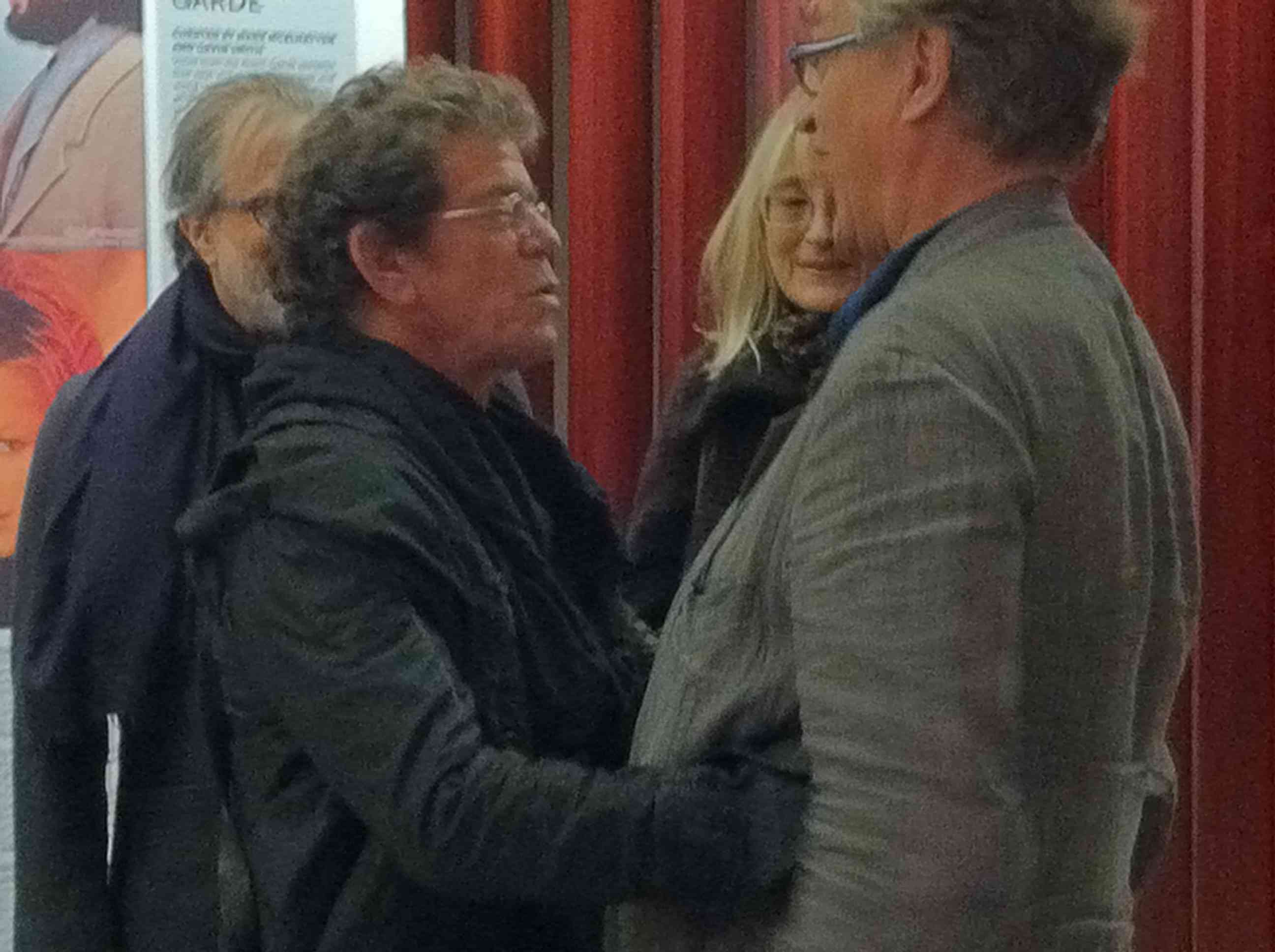
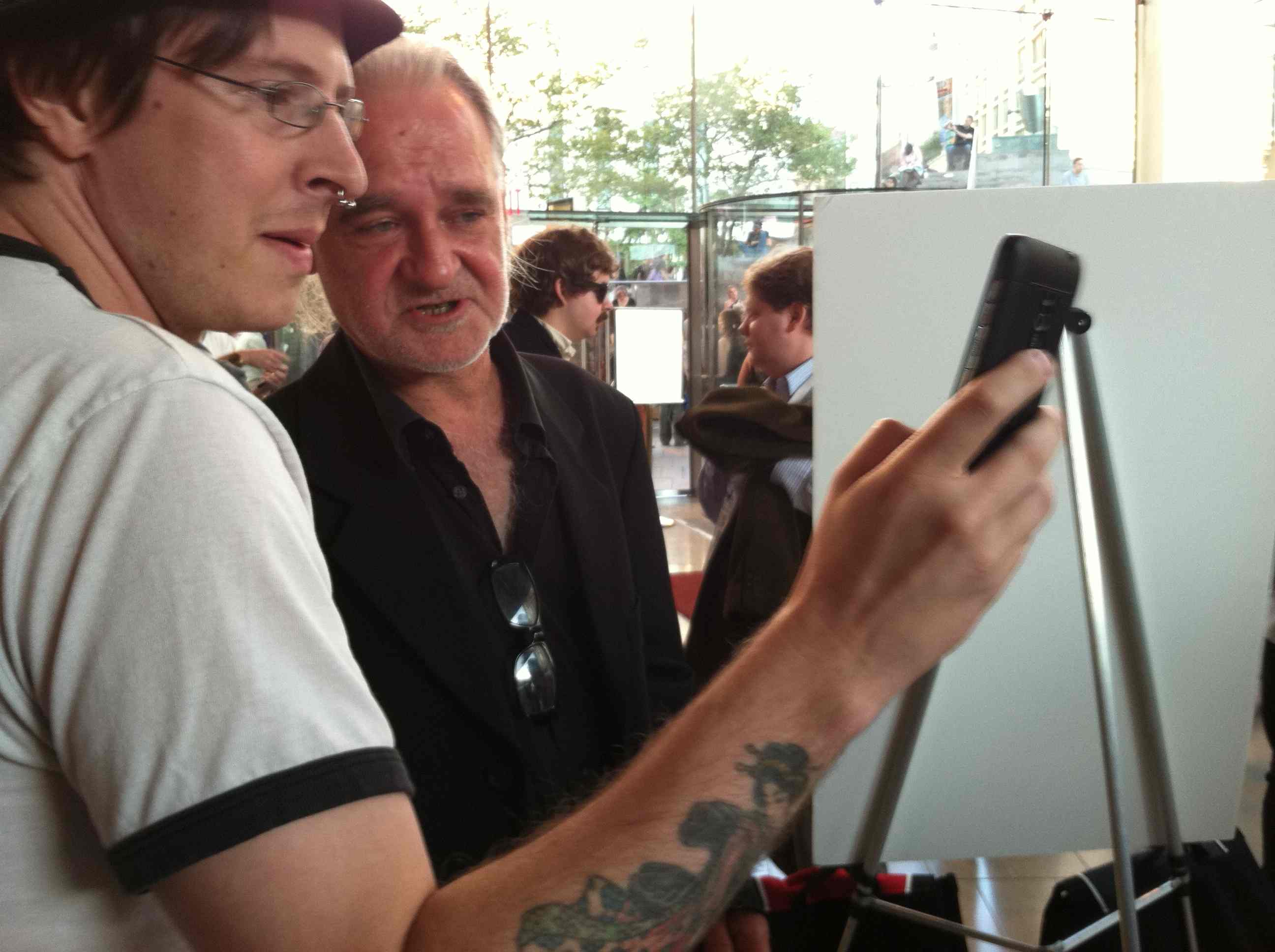
Lou Reed imploring his friend, Wim Wenders, to make Milton the Paparazzo with the iPhone go away.
Lame Adventure 240: Let’s Make a Deal

Two years ago October I renewed my subscription to The New Yorker, a magazine I have been subscribing to as of last count, a million years.  Two years ago I landed a very satisfying deal – a two-year renewal for $49.95.  I figured:

Me:  When my subscription is up for renewal again, by then the economy will be back on track, my salary will be better, and all will be right in the world.  Sweet!

Two years later, everyone I know (myself included), as well as millions I don’t know (the 99) are all continuing to suffer as things continue to go very  economically wrong in this world.  Sucks!  On top of that, my subscription to The New Yorker is again up for renewal and I was not getting offered any deals remotely comparable to what I got two years ago.

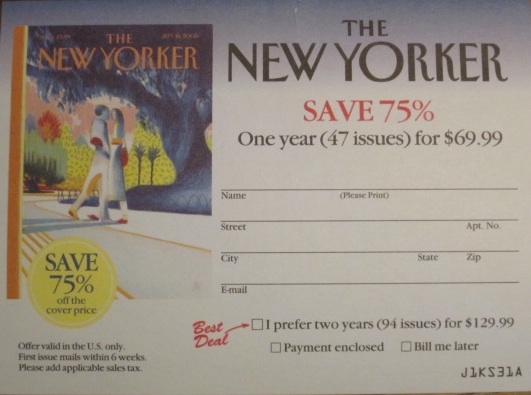
The blow-in card proclaiming that renewing for two years to the tune of $129.99 because that was “the best deal” outraged me.

Condé Nast, you can't be serious!

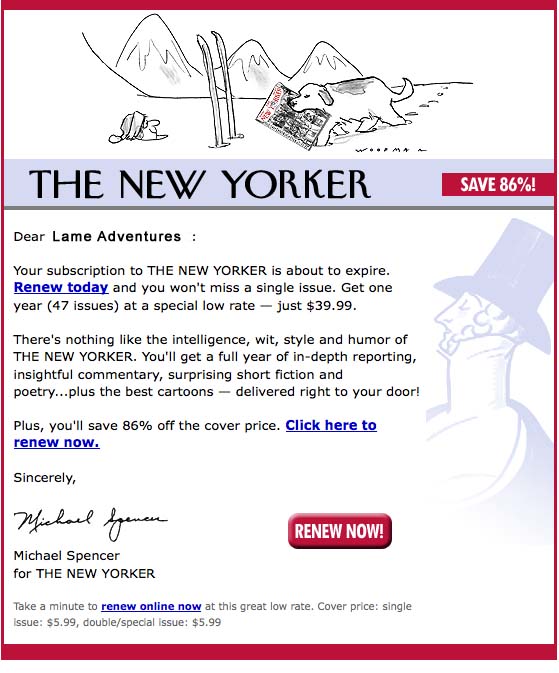
The email they sent me to renew at $39.99 was disappointing.

This is supposd to make me happy?

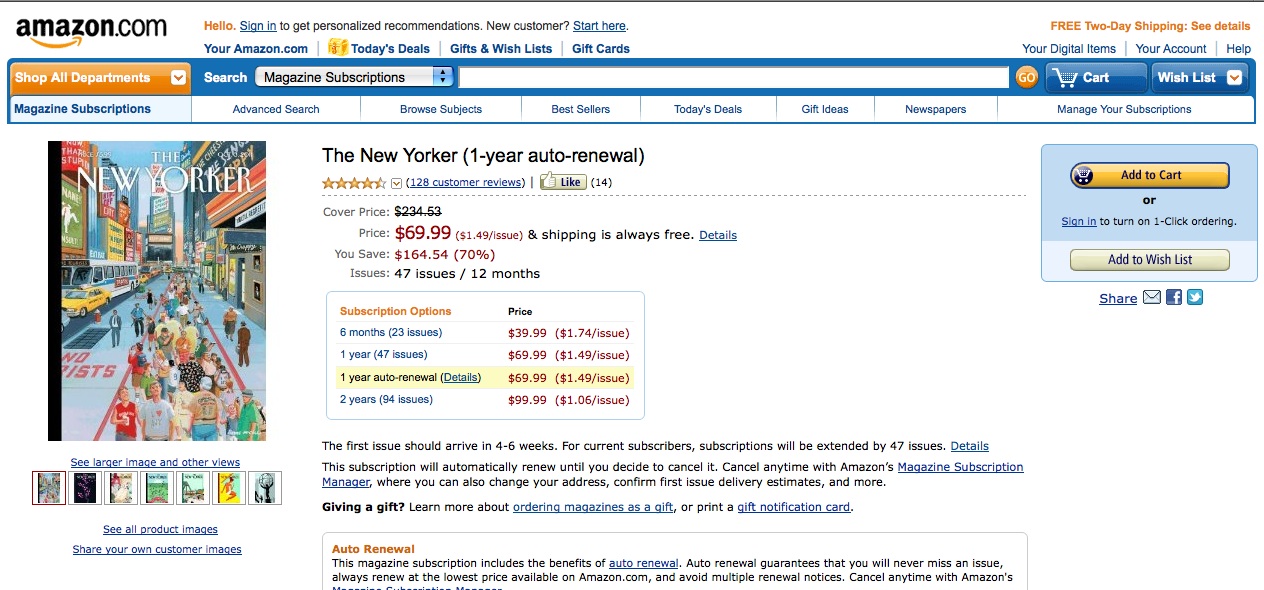
I then did what I always do when searching for a bargain, I logged onto Amazon.  Even Amazon let me down with their one-year renewal for $69.99 and two years for $99.99.

Sound effect: the downbeat.

Resigned to the reality of these inflationary times, I decided that I would have to shell out $39.99.  Before logging off, I decided to peruse the customer reviews when I read one written by “katehof” from Norfolk, Virginia.

“You might get a better deal by calling The New Yorker subsciption (sic) office directly: 800-825-2510. My mailed renewal notice price was $89.95/2 years, but they offered me $50/2 years when I called and spoke to a CSR.”

I called the number and got through to a customer service rep called Dana, but I suffered a brain freeze and called her Amanda, the name of Coco’s new assistant, who I have already called both Miranda and Penelope.  This was almost as awkward as a business call I had two weeks ago with a very patient, polite and professional chap named Enrico, one of my company’s computer systems customer support specialists.  As Enrico was helping me set up a monthly tile purchases report that my boss, Elsbeth, had been demanding for the better part of three years, I was multitasking.

I was reading my personal email.

My longtime friend, Martini Max, sent me a missive where he referred to me as “Bartelby”.  Suddenly, Enrico went silent during our conversation.  This struck me as odd and I wondered if we had been disconnected, until it dawned on me that I was now calling him Bartelby.  This prompted me to stop reading my personal email, to ignore my momentary lapse into Demented-ville, and to immediately resume calling him Enrico.

While on the phone with Dana we had the following exchange:

Me:  Can you provide me with a better renewal rate?

Dana:  I can give you one year for $29.95 or two years for $39.95.

Me:  If I tossed ten more bucks your way, would you give me three years for $49.95?

Dana:  Hold on.

Short pause.  Dana looks into the Orwellian computer system and discovers that I’ve practically been reading this magazine since birth.

Dana:  Okay, you can have three years for $49.95.

Me:  Wow, that’s great!  Thanks!

That’s 141 issues at $5.99 each that would cost $844.59 off the newsstand, or 35 cents a copy delivered to my sanctum sanctorum via this thrifty renewal rate, provided that my marginally competent US Postal Service letter carrier can handle the assignment of delivering every issue.  For a moment, I considered asking Dana if I paid $100 for my renewal, could I just have a lifetime subscription?  Yet, I thought that might be pretentious.  Instead I asked her:

Me:  What happens if I die between now and then?

Dana paused.  Apparently, that macabre question threw her for a loop.  She was talking to a potential dead woman.

Dana:  Let’s hope you don’t, but if you did, the remaining issues in your subscription can be transferred to someone else.

To me, that’s almost as good to know as that 1-800 number.  Thank you katehof from Norfolk!

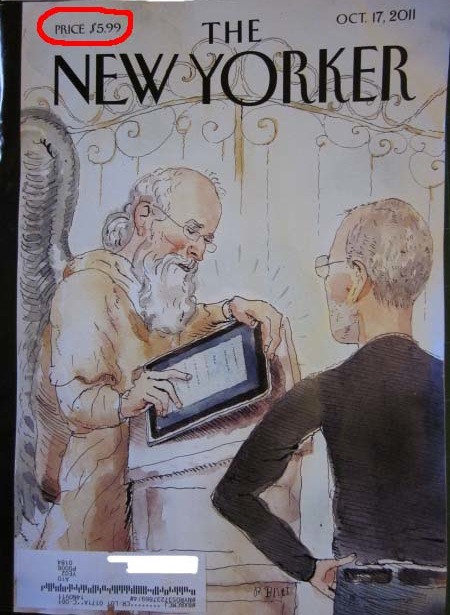
Poignant cover by Barry Blitt for this week's issue. Note the price, $5.99. Ugh.

Lame Adventure 239: New York Film Festival Triple Play

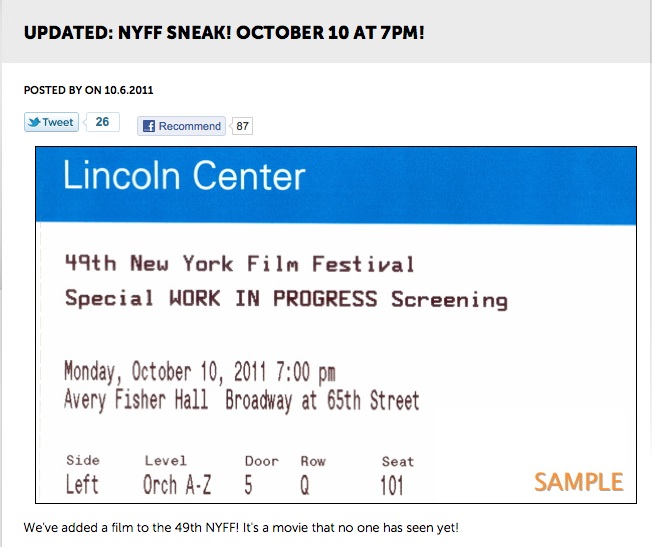
Milton and I have recently seen three very diverse films at the New York Film FestivalShame, The Turin Horse and the Special Work In Progress Screening.

What might this film be?

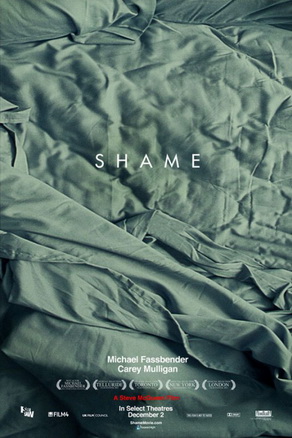
Shame is an erotically charged psychological drama directed by Steve McQueen about Brandon, an affluent, Manhattan-based sex addict in his early-30s, brilliantly played by charismatic, Michael Fassbender, who makes this relentless horndog sympathetic.  Brandon lives a successful double life earning pots of money in his high tech job, while screwing anyone he can buy or bang for free at any hour of the day or night.  When overcome with the urge in the office, he visits the men’s room for a wank.  A quiet evening at home involves pounding a beer and eating take-out Chinese while streaming his favorite porn site.  Riding the subway into work he exchanges such penetrating eye contact with a woman doling out a boatload of come-hither glances back at him, one feels like a voyeur visualizing exactly what he’s imagining he’d like to do to her.

Brandon is content with satisfying his disconnected sexual compulsion until Sissy, his emotionally needy, hot mess of a cabaret singer sister, played perfectly by Carey Mulligan, invades his well-ordered empty life.  When he watches her perform New York, New York dirge-style, he is so overcome with emotion he cannot stop a tear from rolling down his face.  Needy Sissy also invades her brother’s privacy and discovers his secret, prompting him to suffer an existential crisis in response to her cloying need for love and connection.  Following one of their battles, he takes impulsive action to cleanse himself of his habit.  He even tries dating a co-worker with conventional ideas about relationships, but that temporary fix reinforces his natural inclination for the detached and impersonal.  As Sissy craves rescue, Brandon is trapped in his desire for escape, colliding penchants that ultimately exact heavy tolls on both of them.  As the ending credits rolled I was unsure what I wanted to do more, weep or take a shower.  Milton declared:

Milton:  Compared to what we’re seeing next, this was Disney.

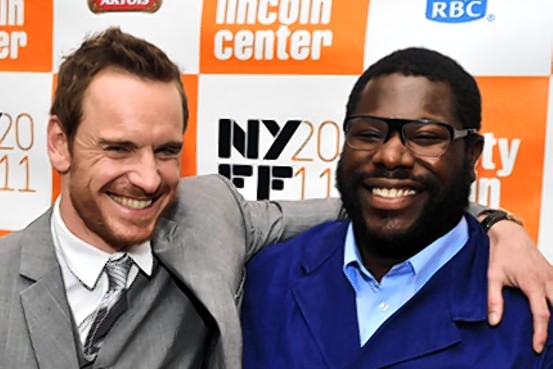
Star Fassbender and Director McQueen at the NYFF.

What we saw next was the Hungarian filmmaker Béla Tarr’s last film, The Turin Horse, a 146 minute black and white opus that was inspired by a horse that Friedrich Nietzsche saw being whipped.  This act of brutality upset Nietzche so much he threw his arms around the animal to protect it and then he pretty much went off his rocker until he died ten years later.  This film is ostensibly about what happened to the horse, but the narrative is so lean, it’s borderline anorexic.

It opens with a grizzled peasant with a paralyzed right arm who looks 70, but is probably 45, driving a wooden cart pulled by his weathered workhorse through a fierce windstorm.  Once home, he is wordlessly met by his adult daughter, who looks 40, but is probably 20.  They go about their routine of unharnessing the horse from her cart, putting her in her stable, and then they enter their stone house where she helps her father undress, and redress, he lies down, and she boils potatoes for their meal.  When the potatoes are cooked, she announces, “It’s ready.”  They eat wordlessly with their hands.  She clears the table and then sits at the window with her back to the camera watching the wind wreak havoc outside until her father orders offscreen, “Go to bed.”

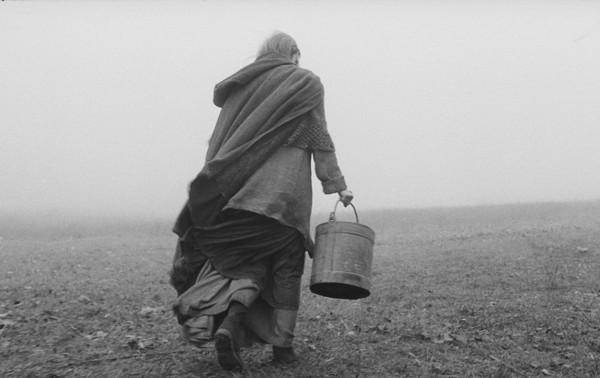
Fetching water.

This segment is followed with the next six days of their lives, basically a repetition of the same routines in their thankless existence — fetching water from the well, dressing, undressing, boiling potatoes, eating potatoes, drinking a shot of palinka (a Hungarian fruit brandy), occasionally dealing with the horse that is looking increasingly ill, getting a visit from a gasbag neighbor, getting a second visit from an unwelcome band of gypsies that leave without incident, the well running dry for a reason that is never explained, an attempt to leave, failing to leave and finally, returning to what could be their doom — all while that windstorm of biblical proportion is blowing.  The storm stops, the lantern no longer lights, without water, the potatoes can only be eaten raw, and the screen fades to black.

How I managed to stay awake, much less find myself completely riveted to the monotonous routines of these two miserable souls essentially living the saying, “Life’s a bitch and then you die,” is a testimony to whatever it is that Béla Tarr does with the camera.  I never looked at my watch once.  In fact, it never even occurred to me to look at my watch.

As the ending credits rolled, Milton eloquently confided:

Milton: I never want to see a potato again if that shit ain’t fried.

Afterward, Dennis Lim, a member of the festival’s selection committee, conducted a q&a with Béla Tarr, who insisted on standing throughout.

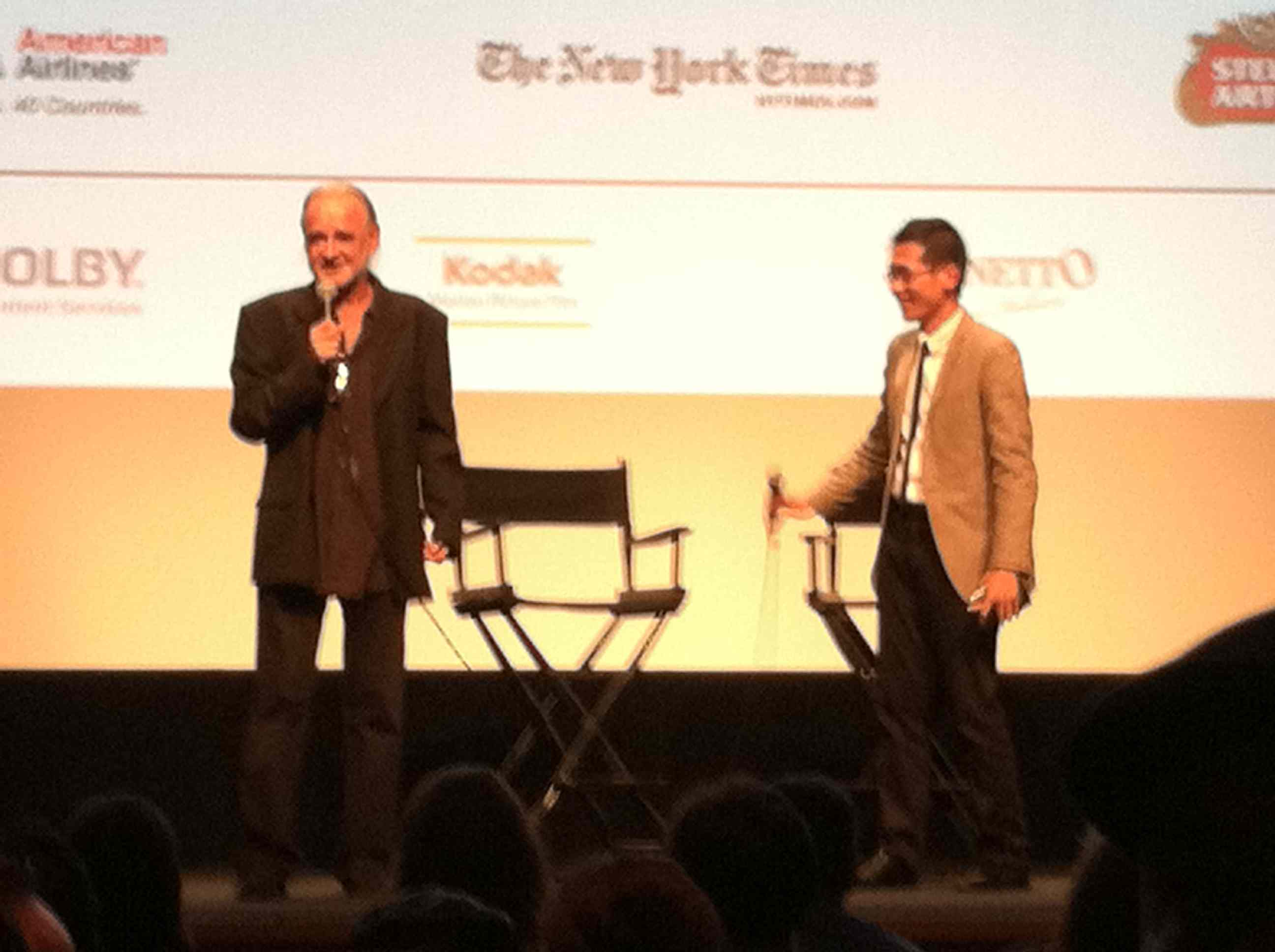
Béla Tarr and Dennis Lim on stage at Alice Tully Hall

Béla Tarr succinctly explained it best why this film works so well for the viewer:

BT: The details are more important than the stupid story.

He answered the question about why this is his last film with a question:

BT:  Do you think I can say more?

He added that he felt no reason to repeat himself.  Afterward, Milton shared another confidence with me:

Milton:  I want to screw Michael Fassbender and marry Béla Tarr.

Another man blocking Milton's path to Béla's heart.

Our mystery work-in-progress screening was for Martin Scorsese’s adventure in the world of 3D, Hugo, based on the novel by Brian Selznick titled, The Invention of Hugo Cabret.  Hugo is a caper about a clever orphan boy who secretly lives in a railway station in Paris with a broken automaton he’s determined to repair.  On a narrative level, the first hour is so leaden with cliché chase scenes and contrived suspense, it made The Turin Horse seem light as a soufflé.  In the second half, it veers into an entirely unpredictable direction when it turns into a compelling film history lesson about filmmaker Georges Méliès, before reverting back to more contrived shenanigans, yet another chase, and the predictable tugging at the heartstrings ending.  I looked at my watch several times while watching this one.  Hugo is scheduled to open November 23rd in time for Thanksgiving.  Pass the turkey.

Lame Adventure 238: New York Film Festival – Melancholia

It seems perversely fitting that on the day after Steve Jobs buys his rainbow, Milton and I are attending a screening of a film at the New York Film Festival called Melancholia.  Written and directed by Lars von Trier, this is a story about the end of the world.  At this moment, many Mac devotees including myself felt that the world had ended a bit when we learned that Steve had checked out.   Milton has an iPhone, his first taste of Mac hardware but his Dell desktop has often been the bane of his existence prompting me to bark:

Me:  Get a Mac!

On cue, he will grouse about having just paid off his PC, and I will issue my usual taunt:

Me:  Once you have Mac you’ll never go back.

Milton and I had not planned on attending any NYFF screenings of films with distribution, but we both highly regretted not bending our rule for the latest from reliably controversial Lars.  When Melancholia played Cannes last spring, word spread fast that it was one of his best films thus far in his career.  Then he blew all the great press devoted to his work by suffering diarrhea of the mouth at a post-screening press conference when he went on a stream-of-consciousness tangent about Nazis, Jews, being a Nazi, etc.  This stupidity quickly got him ejected from the festival.  Do I think he’s a Nazi?  No.  Do I think he was the king of self-destruction at that press conference?  To get vomitously Sarah Palin here, “You betcha!”  Lars might be the type that recoils from admiration and approval.  Yet, I have no interest in playing Sigmund Fraud (sic) about his psychologically.  Everyone has demons, but most of us keep them under wraps in public or at least when cameras, microphones, and hundreds of reporters are present.

We knew that the Melancholia screening was sold out, but Film Society member Milton visited the box office and asked if any seats were available.  The ticket seller took pity on him and sold him a pair (at his member discount rate) of center section seats in row G; a row that Milton is now referring to as “Row Good.”

An image that probably sends chills up Vera Wang's spine.

This cosmic tale is as beautiful as it is bleak.  The story opens with a brilliant prologue depicting mini-scenes of destruction leading up to the grand kahuna of “holy crap, did we see what we just saw” moments  while music from Wagner’s Tristan and Isolde graces the soundtrack.  The prologue segues into the first part of the film called Justine.  Kirsten Dunst plays Justine, a new bride who arrives two hours late with her groom, Michael (Alexander Skarsgard), to their wedding reception held at her sister Claire’s lavish mansion.  A two-word description of the wedding reception is ‘emotional disaster’ as Claire (Charlotte Gainsbourg delivering yet another pitch-perfect performance), struggles to make this toxic celebration a success.  Unfortunately, she is fighting an impossible battle with forces beyond her control including her bitter divorced mother (Charlotte Rampling) delivering a speech so withering I became infected with Milton’s giggles.  The foremost force that resists Claire’s good intentions is Justine, who grows increasingly detached from her own party to a socially suicidal degree.

The second part is called Claire, the sister that is fighting hard to maintain some semblance of normalcy in the life she shares with her husband and young son, a tall order to fill since psychopathic Justine is around.  The film unfolds with a sense of calm, but as worried Claire’s anxiety about the fate of the world as a rogue planet approaches escalates, Justine, who has a premonition of what’s to come, seems at peace.  Meanwhile, Claire grows increasingly unhinged and considering the circumsances, who the hell wouldn’t?

If there is a recurring theme throughout the entirety of the film it’s one of hopelessness.  In the world according to Lars it seems that no matter how hard we try to make things right, to play by life’s rules, to be prepared in the event of an emergency, or even if we consciously stop trying at all, either way it doesn’t matter what we do.  Forces beyond our control are out there that are going to crush us one way or another.   On the upside, this makes me feel a lot less lousy about my inability to get out of bed to get to work on time. 

As the ending credits rolled, many audience members sat in a daze.   This thought provoking highly original work is going to stick in our heads quite a while.

Lame Adventure 237: New York Film Festival – George Harrison: Living in the Material World

Milton and I attended the sold-out screening of the HBO documentary George Harrison: Living in the Material World at the New York Film Festival.  This 208 minute film directed by Martin Scorsese with the cooperation of Harrison’s widow, Olivia, will be shown in two parts on HBO starting tonight.

We had fantastic seats, seventh row, almost dead center.  The filmmaker, Wes Anderson, was sitting behind us.  We saw Fisher Stevens and we also thought we saw the composer Philip Glass.  I pointed out a guy that I thought could have participated in a John Lithgow look-alike contest.

Milton:  He could have entered but he would have lost.  I can’t believe we have VIP seats!

Me:  Someone probably got fired for making that mistake.

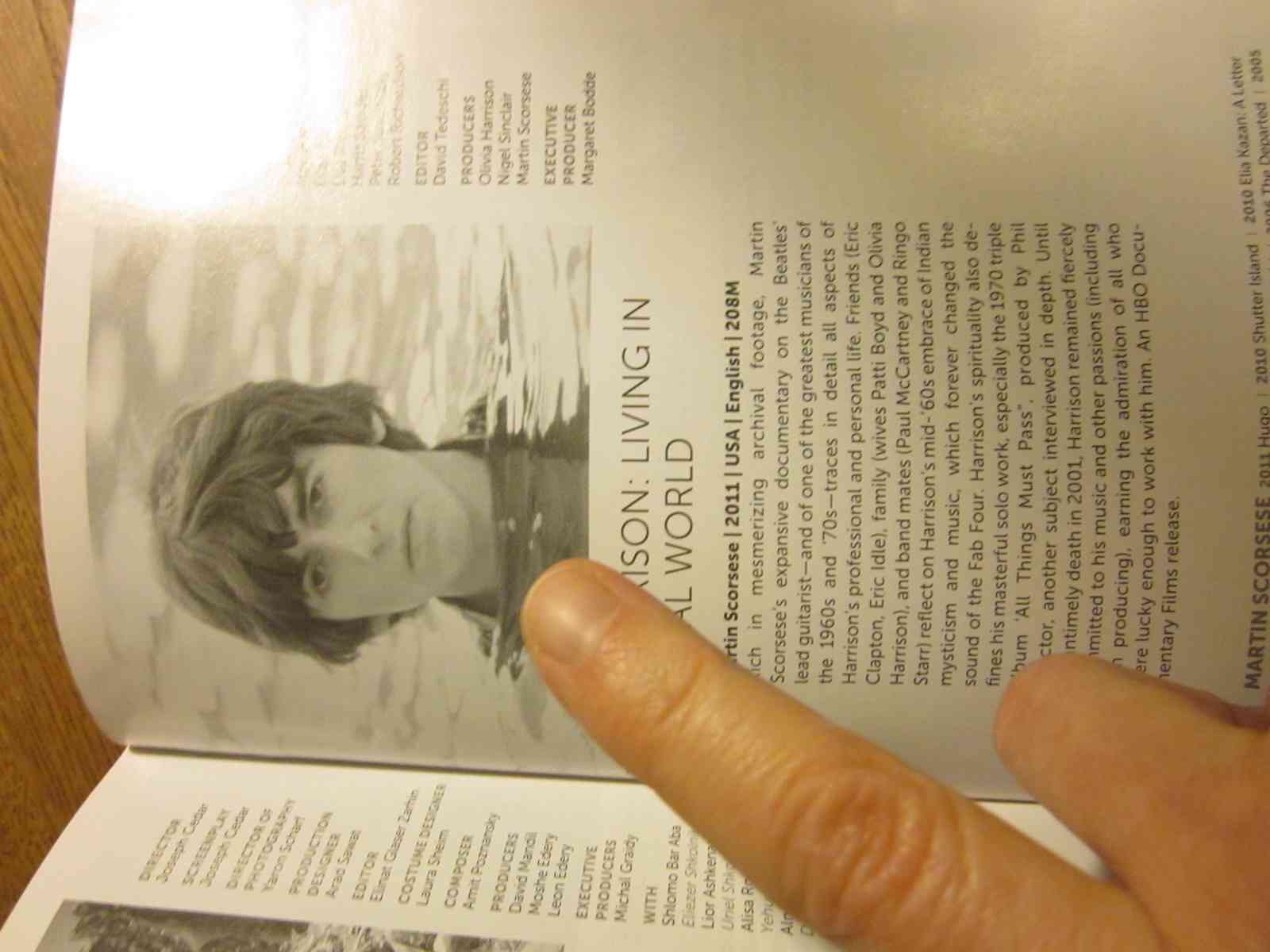
As I was leafing through my program, chatting with Milton, I reached our film’s description page.  The woman sitting next to me, a Bjork-wannabe in the appearance department, floats her finger over George’s face in the photograph and mumbles his name into my left ear.

Floating finger re-enactment.

This unsolicited gesture captures my attention. I don’t want to encourage her but I don’t want to appear rude.

Me:  Yes, that’s George Harrison.

Milton mumbles her name into my right ear.

Milton:  Weirdo.

Olivia Harrison and Martin Scorsese introduce the film.  Then, the lights dim, the screen fills with tulips, and George’s middle-aged face appears in the garden.  He looks at the camera and flashes an ethereal smile.  I instantly feel a lump in my throat, but it just as instantly dissolves because Weirdo unfolds the oversized program guide and starts perusing it using her cellphone as a light source.  She is also leaning over my armrest.  She is so close to me that I can sniff her fragrance, Eau de Gag.

There I am sitting next to a stinky deranged space invader that I’d like to beat with a Rickenbacker guitar while watching what might be the definitive documentary about one of the most spiritual rock stars ever.  Instinct tells me that if I address her, this could get very ugly, very fast.  I inch closer to Milton and stay focused on the film, but I do notice that when I react audibly to whatever is happening on the screen, it  distracts her from her program guide reading and I can feel her staring at me.  If I were  to look at her, I know she’d be looking at me square in the face.  I stay focused on the screen.

Every so often her illuminated phone chimes.  It also fully rang once.  She quickly killed the ring, but the guy sitting next to Milton leaned forward and did address her.

Guy Sitting Next to Milton:  Shut that off!

She followed his order.  At that moment, I could have had that stranger’s child.

The first half of the film, told without narration and deftly edited by David Tedeschi, reveals George’s early life through archive footage and home movies, as well as interviews with the man himself.  This footage is intercut with interviews with key talking heads including the surviving Beatles, Paul McCartney and Ringo Starr, record producer George Martin, Harrison’s ex-wife Pattie Boyd, Eric Clapton, Yoko Ono, Phil Specter (filmed before his world imploded), and many others sharing anecdotes and personal insights about “the quiet Beatle”.  Until Paul McCartney revealed it, I never knew that young George referred to his highly stylized pre-Beatle haircut as “the turban.”

The film conveys George’s frustration as being the lead guitarist to the Beatle’s two domineering writers, John Lennon and McCartney.  In the beginning Harrison’s songwriting talent was undeveloped, but it blossomed over time (being in the company of Lennon and McCartney could not have hurt) but he had a tough time getting his less commercial songs on Beatle albums.  He smashed one hit out of the park with Something.  In the second half of the film, an interviewee suggests that although this classic Harrison composition is about a woman, it could just as easily have been about his close relationship with God.

Part two of the film, the post-Beatle half, devotes much more time to George’s original music as well as to his spirituality.  This was the half where I caught myself nodding out on several occasions.  Yet, whenever he or Ravi Shankar began strumming a sitar, I quickly regained consciousness.

The more controversial areas of George’s life including his philandering and his recreational drug abuse were downplayed.  Olivia skirts the topic of his indiscretions.  It was clearly a painful topic for her, but she answers her own question when she herself asks the secret to a lasting marriage:

Olivia: You don’t get divorced.

A glaring omission was not mentioning that George lost a major copyright infringement suit that lingered for years.  A judge ruled against him when it was deemed that he subconsciously plagiarized the Chiffon’s He’s so Fine when he wrote My Sweet Lord.  Milton and I are both deaf to the similarities.

What we also found baffling was why the filmmakers were so coy about the specific cancer that led to George’s death in 2001.  He was seen smoking cigarettes throughout the film and was diagnosed with throat cancer in 1997.  The subject of his cancer from the initial diagnosis through where he traveled for treatment was downplayed. Yet, it is mentioned that his cancer was in remission when an intruder attacked him in his home on New Year’s Eve 1999.  Dhani, George and Olivia’s only child, eludes that the stress of that brutal attack may have expedited his father’s death.  I am sure that that attack did not help George recover, but I am also sure that smoking a few packs for 30 or 40 years may have also contributed significantly to his passing.  Why not be straightforward about that?  I don’t think this film was funded by Philip Morris.

As we left the theater Milton observed:

Milton: I feel like I was lied to but in a very clever way.
Overall, this film is very entertaining, but there are gaps in the narrative.  As for Weirdo, she left her seat at intermission and did not return.  Maybe Krishna or possibly George himself interceded on my behalf.

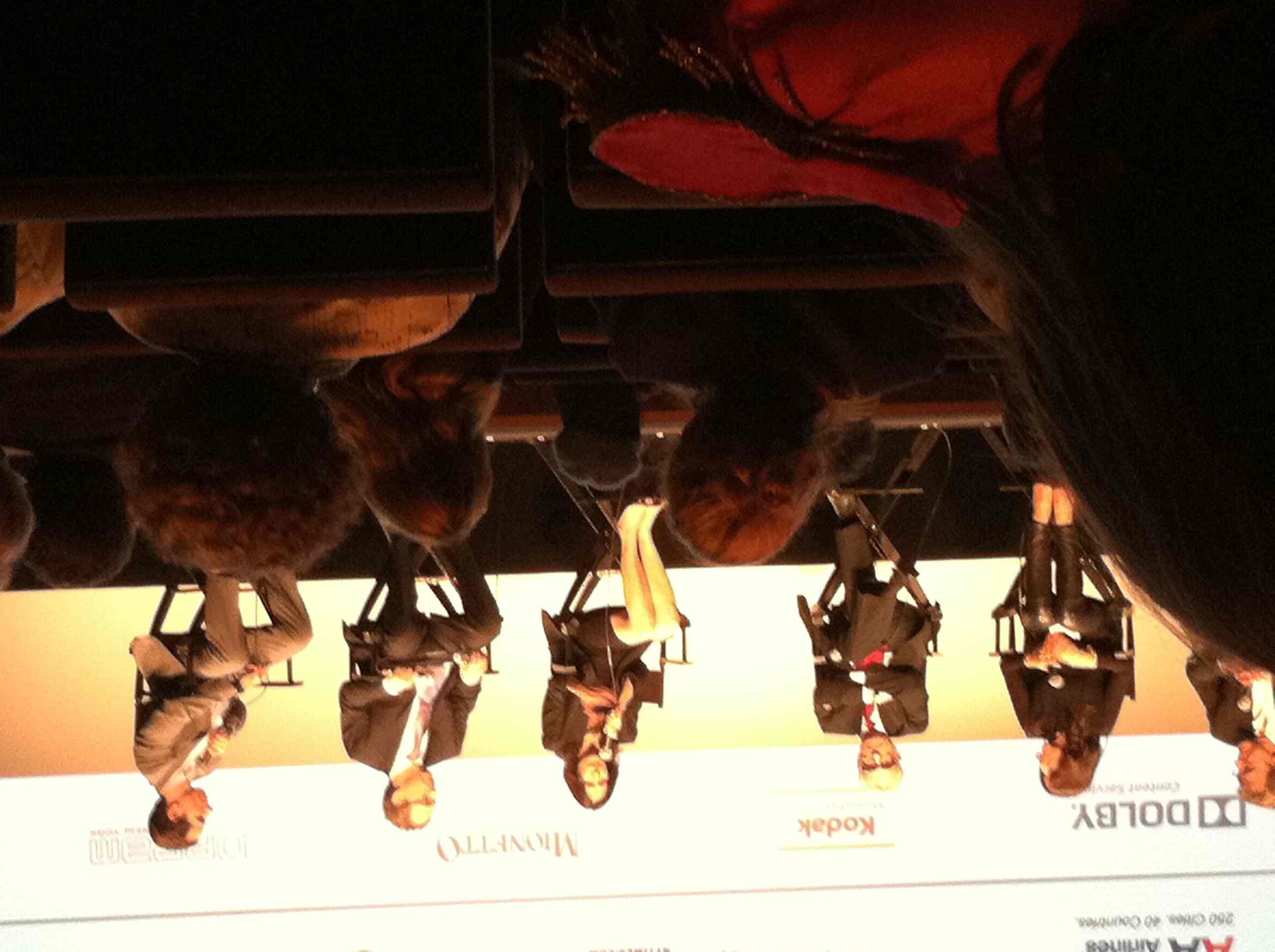
Forbidden panel discussion iPhone photo that nearly got Milton handed his head on a plate by a watchdog usher. Left to right producer Nigel Sinclair, Olivia Harrison, Martin Scorsese, Margaret Bodde, David Tedeschi, and moderator Scott Foundas. Note woman in foreground wearing Sgt. Pepper-ette collection coat.

Lame Adventure 236: Breakfast with Ben-Hur

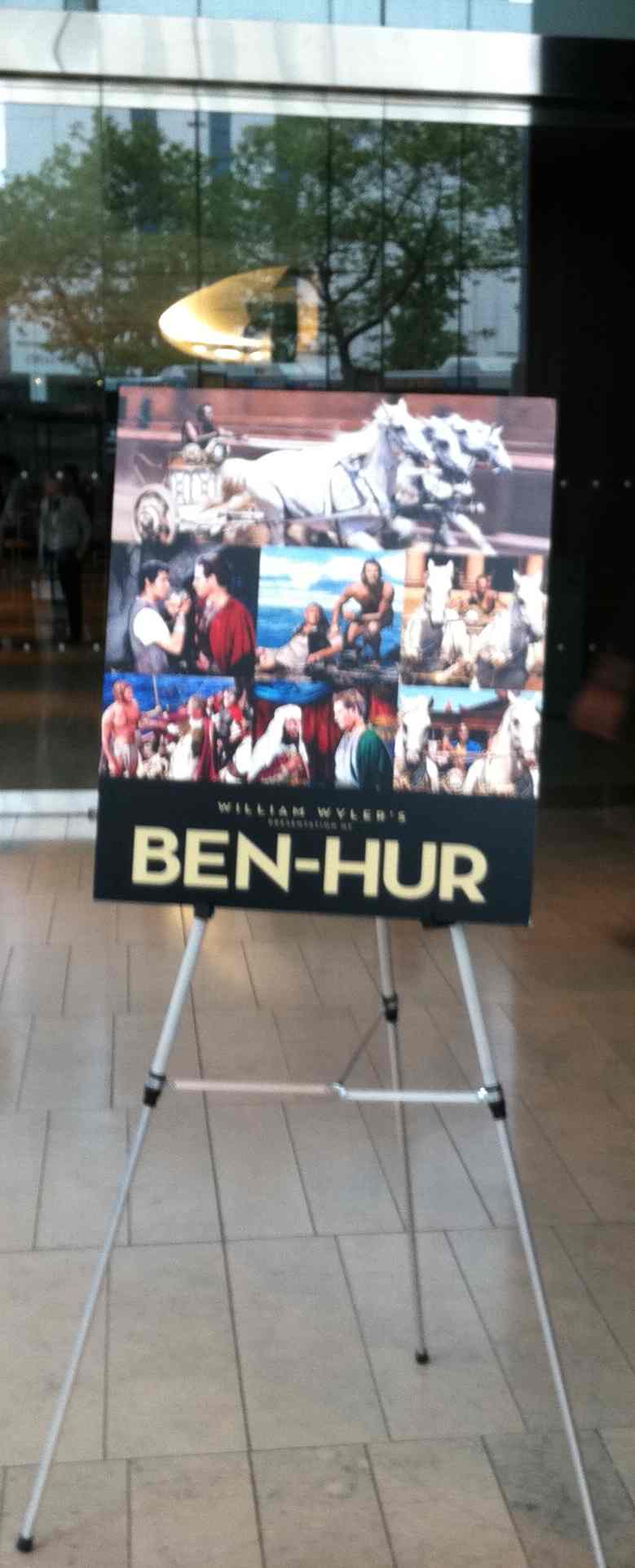
Now that the New York Film Festival is fully underway, Film Society of Lincoln Center member, Milton, was notified that he could have a pair of tickets to Saturday morning’s special screening of Ben-Hur.  This was a rare big-screen showing of the gloriously restored spectacle from 1959 that was directed by William Wyler and stars Charlton Heston.  This lavish epic that cost $15,900,000 to produce between May 1958 and March 1959 ($122,709,369.72 in 2011 dollars) won eleven Academy Awards, a feat that has only been equaled by two other blockbusters that were cat-nip to the masses, Titanic (1997), and The Lord of the Rings: the Return of the King (2003).  Milton called me at work on Friday:

Milton: Do you want to see Ben-Hur at 10:30 Saturday morning?

Me: I’m going to see Greg perform at a bar with Coco, Albee and Enchilada tonight.  I anticipate drinking heavily.  Isn’t it three hours long?

Milton:  Closer to four.  Have you ever seen it?

Me:  A religious epic?  Me who endured twelve years of atheist training* in my youth?

[*Atheist training: how I refer to my Catholic school education.]

Milton:  This is your opportunity to see the chariot race on a wide screen.

Me:  I’ll probably feel run over by a chariot.  I’ll need triage.

Milton:  They’re giving me free tickets.

Me:  Ben-Hur with a hangover, here I come!

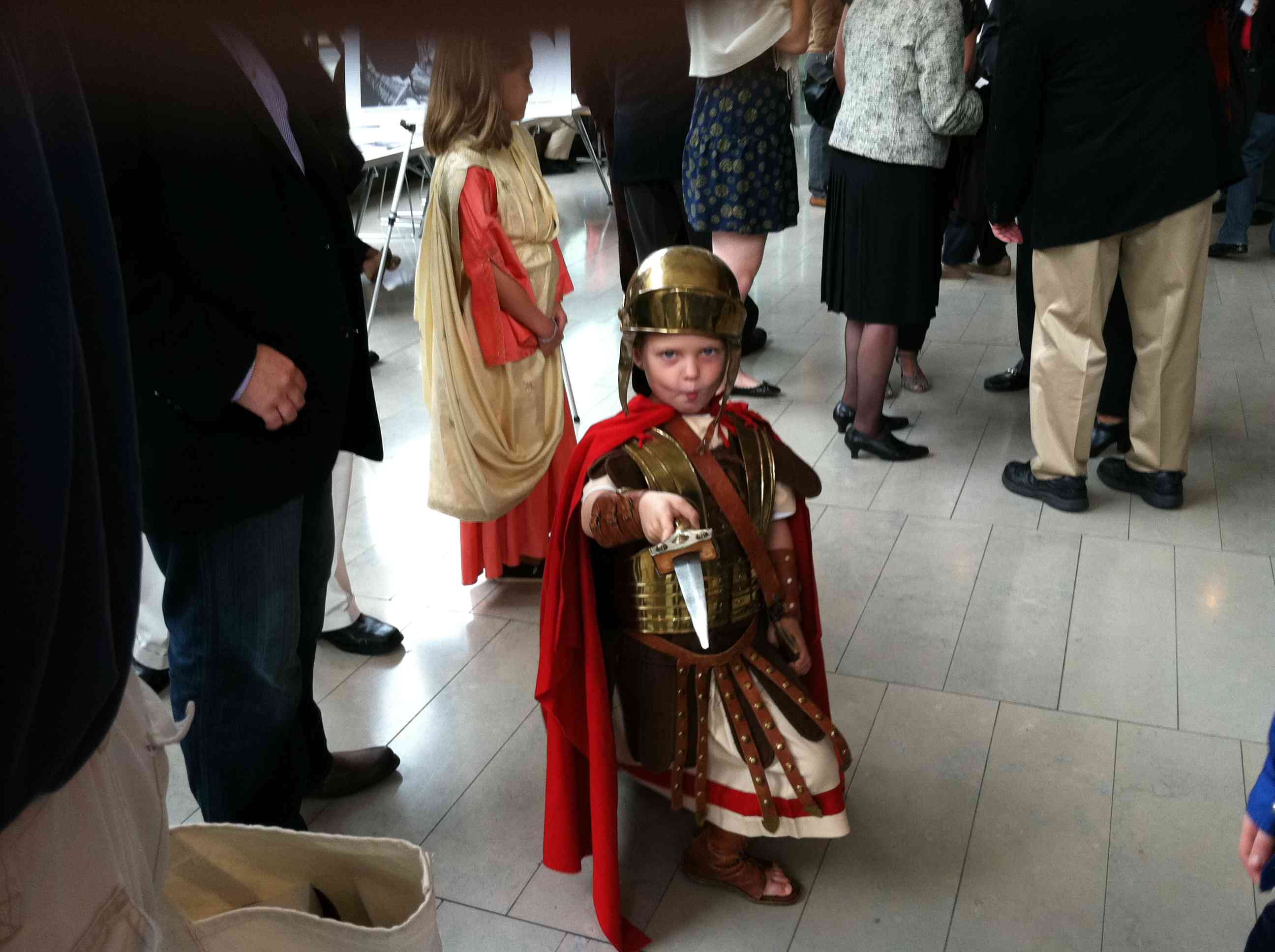
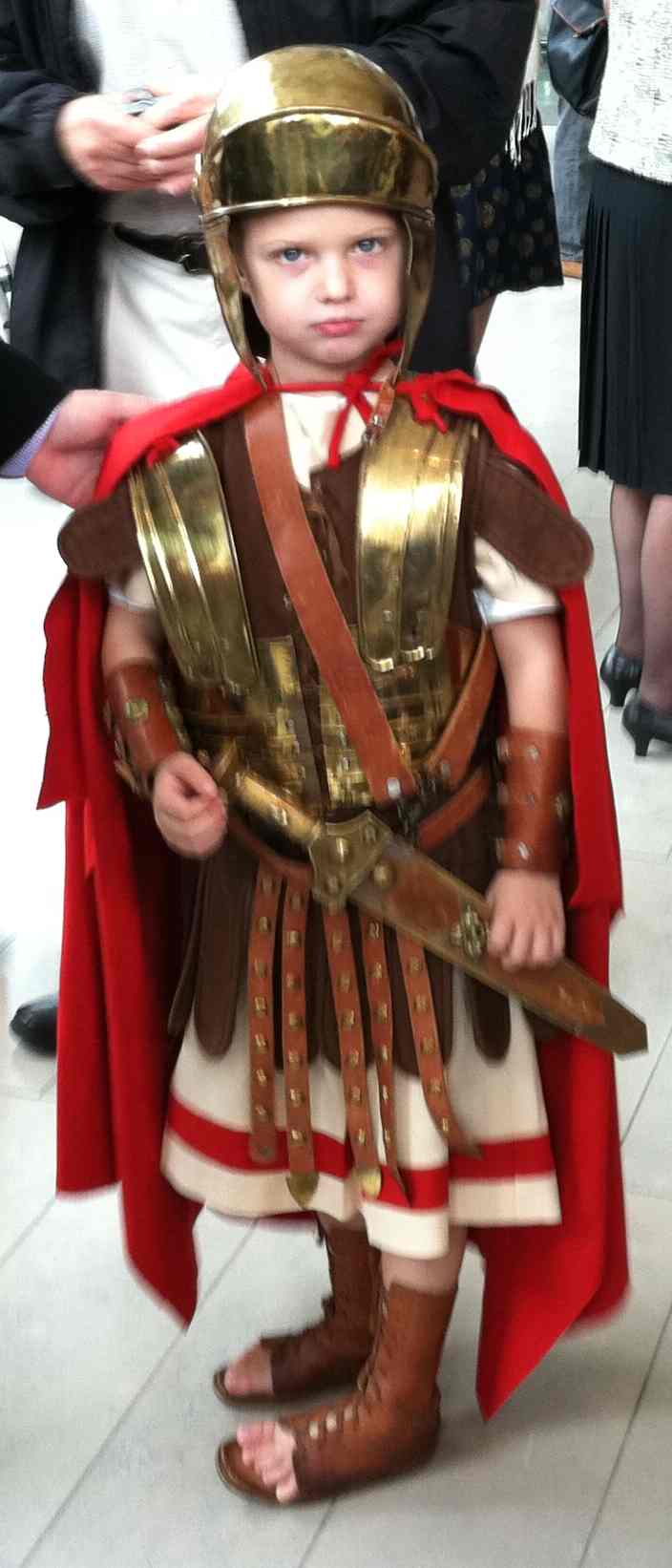
While waiting for me, Milton milled around the lobby of Lincoln Center’s Alice Tully Hall snapping pictures with his iPhone when he encountered this young gladiator, William Wyler’s great-grandson.

Little gladiator threatening to stab Milton the Paparazzo in the pancreas.

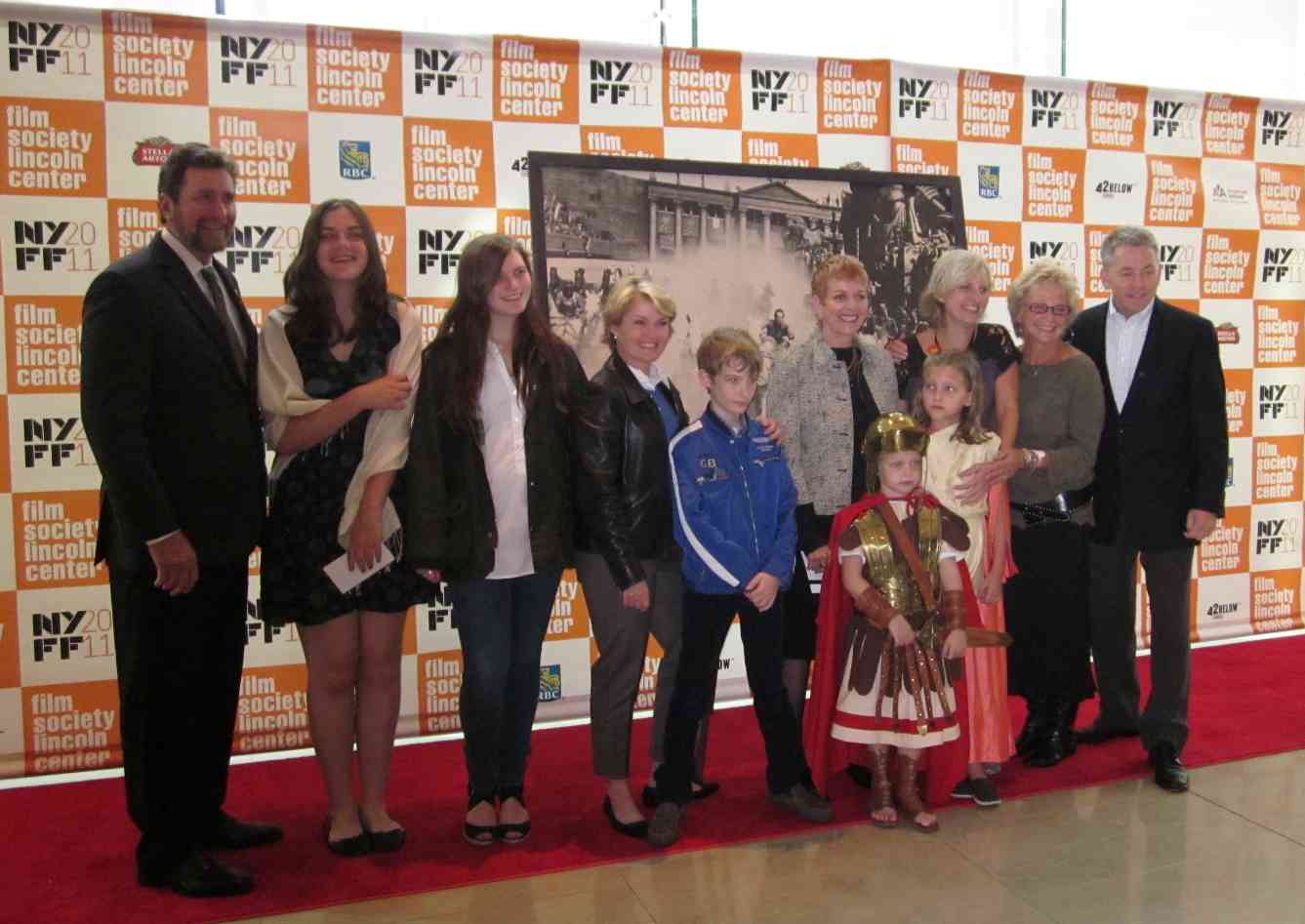
Both the Wyler and Heston families participated enthusiastically in this event and made it extra special for the audience.

Proud Wyler and Heston family members.

Wyler’s daughter, Catherine Wyler, with Charlton Heston’s son, Fraser Heston, delivered a few personal anecdotes by means of introduction.  The costumes that Catherine’s grandchildren were wearing had been designed by the MGM wardrobe department for the film.

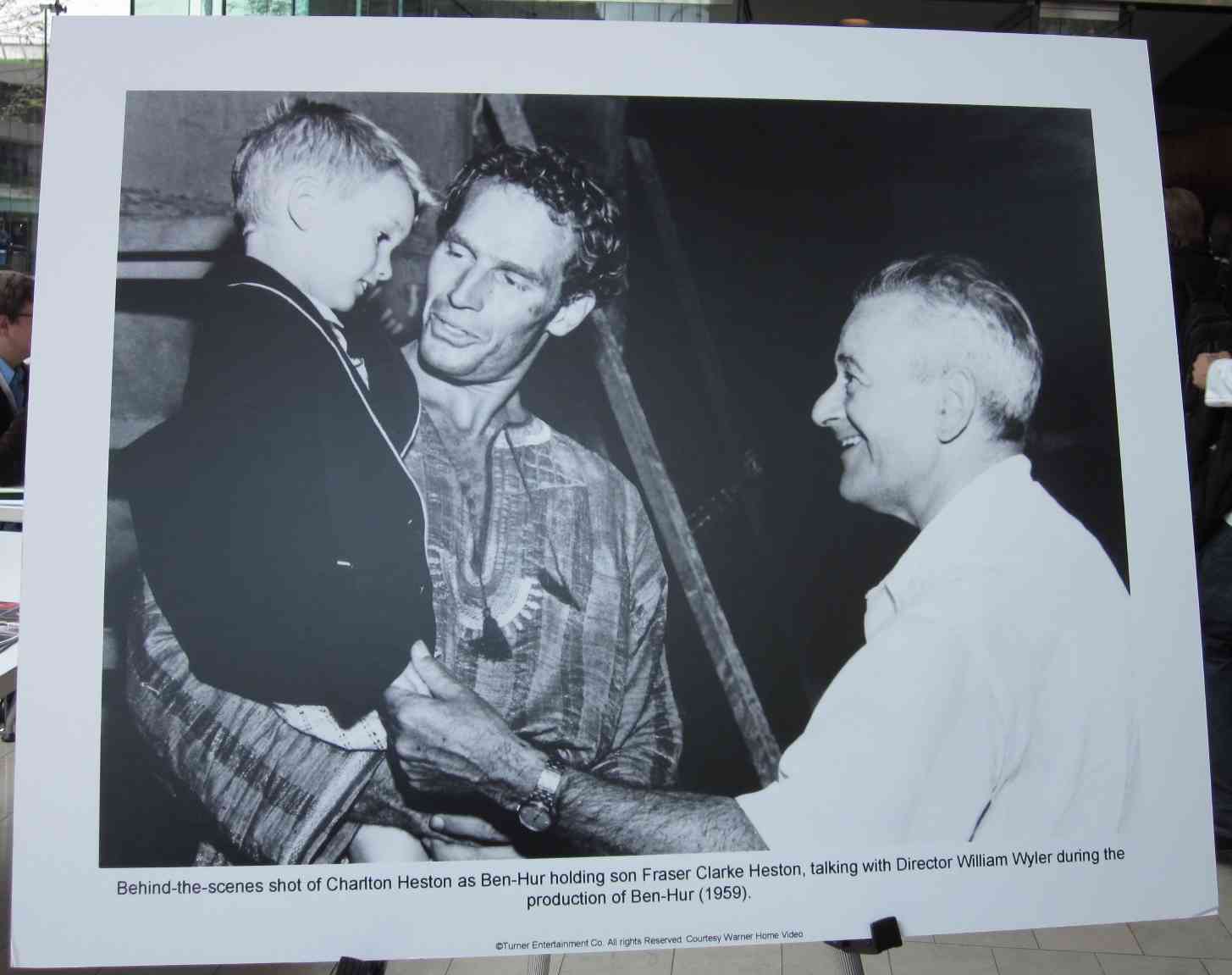
Fraser told us that his father filled his sandbox with sand from the set telling him that this wasn’t just any sand, “It’s MGM sand!”

Fraser Heston with his dad and William Wyler.

He said his father was suffering anxiety about the chariot race so he discussed his concerns at length with Yakima Canutt, the stuntman in charge of directing that pivotal scene.  Fraser told us that “Yak” listened patiently to his father, pushed back the brim of his cowboy hat, and said, “Chuck, I guarantee you’re gonna win the race.”

The film got underway with a music overture over a blank blue screen.

Me:  Hey, shouldn’t it say “overture” on the screen?

Milton (authoritatively):  They only do that on TV, so you know there’s nothing wrong with your set.

As the overture played, we noticed that the cavernous theater was at most two-thirds full.  Those of us sitting in the crummier seats scrambled quickly to better locations.  We moved five rows back and towards the center.

When the Wyler and Heston families entered the theater there was a bit of a commotion.  It seemed possible that other patrons had moved into their assigned seats.  Slowly they began to angle their way towards us.  We gulped.

Milton (drily): It would be funny if we were sitting in their seats.

Fortunately, we weren’t, the overture ended, and the film began with an army of extras streaming into Judea, followed with a heavy-handed birth of Christ scene.  I thought that the circled twinkling Star of Bethlehem beaming bright blue light into a stable was overkill.  Once inside the stable, Milton got his first attack of the giggles thanks to a perpetually mooing cow that seemed to say to us:

Perpetually Mooing Cow:  Hey, look at me, I’m in the movies!  I’m not steak!

Fast forward 26 years and we meet sexy-brute Messala (played by Stephen Boyd), a decorated Roman soldier who wears a helmet with a maroon brush that reminded me that I needed to sweep my floor when I got home.  His boyhood friend, Judah Ben-Hur (played earnestly by Heston), who has not seen Messala in years, visits.  With tear-filled eyes these guys engage in such an emotional reunion replete with complicated arm shakes, bear hugs and testosterone-filled spear tossings, I ask Milton:

Me:  Are we watching Brokeback Mountain?

Milton suffers his next attack of the giggles.

Milton claims that this gay subtext was due to Gore Vidal‘s contributions to the script even though he did not get a screenwriting credit.  In my post-screening research I’ve learned that Vidal, who was under contract with MGM, was enlisted by Wyler to rewrite Karl Tunberg’s script, a script that Wyler deemed terrible.  Vidal added the overt gay subtext between Ben-Hur and Messala with Wyler’s approval.  Vidal discussed this idea with Stephen Boyd, but he did not mention anything about the gay innuendo to Heston.  Wyler feared that Chuck would freak out.  In many respects the story did seem like a tragic romance between spurned Messala who exacts hysterical revenge on Judah.  Heart-broken Judah cannot believe that Messala can be so cruel.

Approximately two and a half hours and one technical difficulty delay later, intermission arrived:

Milton:  What day is it?

People making a mad dash for the bathroom groused loudly about the theater feeling like a meat locker.  It was freezing but everyone that left returned.  I envied the woman sitting ahead of us dressed like an Eskimo.

If you only see one half of Ben-Hur, the half to see is the second half for that’s the riveting half with the chariot race.  That race is exhilarating.  Yak Canutt did a brilliant job directing it.  His son, Joe, was Heston’s stunt double.  In an unplanned crash, that was included in the film, Ben-Hur’s horses leap over a fallen chariot throwing Ben-Hur over the lip of his vehicle.  Somehow, he (actually Joe Canutt) manages to climb back in.

That was so impressive, our entire audience gasped.

I thought it was interesting that Ben-Hur never whips his horses, but his rival, the sadistic Messala, is in a whipping frenzy.  Messala is so mad, he even starts cracking his whip at his once dear friend.  If you’re looking for subtlety, you might want to skip Ben-Hur, but if you’re curious to see a blockbuster from another era and you have a wide-screen TV, TCM is broadcasting it on Tuesday October 4th, and again on Christmas day.
Although I would have enjoyed it more had Jesus been written out of the story, Milton said that the religious elements did not bother him because it promoted tolerance and acceptance of one another, which I agree is a good thing.  The way lepers were depicted made him reflect on the way people with AIDS were shunned in the early years of the epidemic.  I thought that was an interesting observation, but religion on the big screen still activates my gag reflex.  Aside from the corniness, camp moments, and tightly corseted women sporting impossibly tiny waistlines (particularly sole-surviving lead actor, Haya Harareet who appears as Ester, the slave-girl Judah loves and frees), Ben-Hur still retains plenty of entertainment bang for much of its three hour and thirty-two minute length.  Even this atheist can recognize that is is a masterpiece.

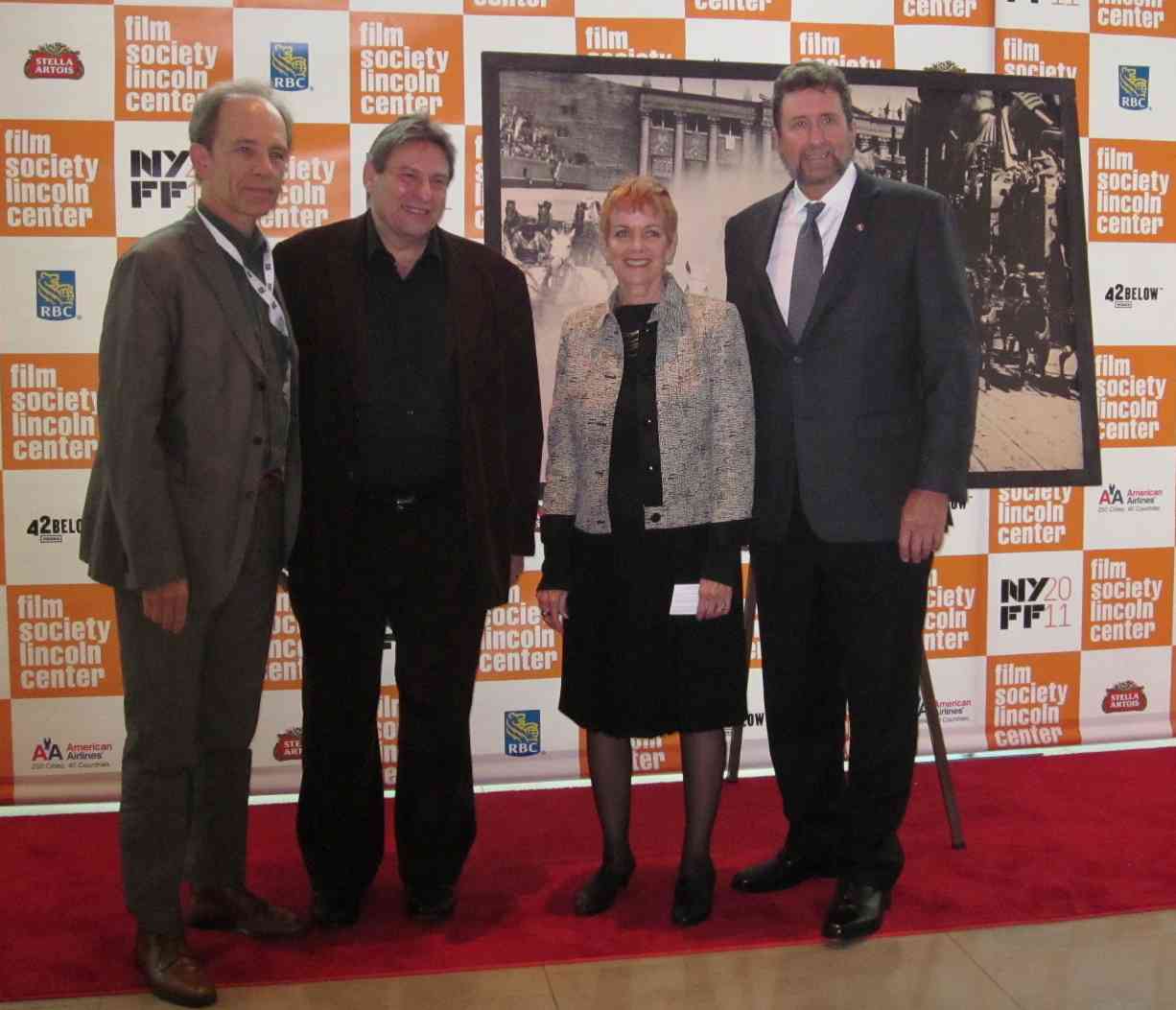
Left to right: Todd McCarthy, Richard Peña, Catherine Wyler, Frazer Heston

You take another picture of me and it's war!

Lame Adventure 235: Christmas in October!

It is that time of year again, Christmas in October for Milton and me.   Here in the Big Apple the New York Film Festival is underway for the 49th time.

Yay, it's here!

Milton is a longtime member of the Film Society of Lincoln Center so we were able to purchase our tickets in advance in August.  This year’s festival is packed with films that already have theatrical release.

For example, opening the festival today is Carnage directed by Roman Polanski (a guaranteed no show).  This film is an adaptation of God of Carnage, Yasmina Reza’s smash hit play that won the Tony award in 2009.  It stars Jodie Foster, Kate Winslet, Christoph Waltz and John C. Reilly.  We figure that most, if not all of them, will attend.

Milton and I were in complete agreement to pass on this one, not because we have issues with Polanski, the story, or the star-studded cast, but it will open theatrically in December.  If we do not luck into a free screening, we’ll see it in a movie theater for $13, significantly less than the $250 opening night admission price (but it will screen three more times at the festival to the tune of $40 or $20).  Milton and I are fine with waiting to see this one later in the year.

What we strive to see are films that have not scored distribution but we also indulge each other’s guilty pleasure.  This year my GP is a screening of a two-part HBO documentary George Harrison: Living in the Material World.  It’s directed by Martin Scorsese and will be broadcast on HBO next Wednesday and Thursday, October 5th and 6th, the day after our screening.  I told Milton that since I can no longer afford to subscribe to HBO I’d like to see all 208 minutes of it in one sitting on Alice Tully Hall’s giant screen.  Milton swallowed hard and said:

Milton (groaning deeply):  Okay.

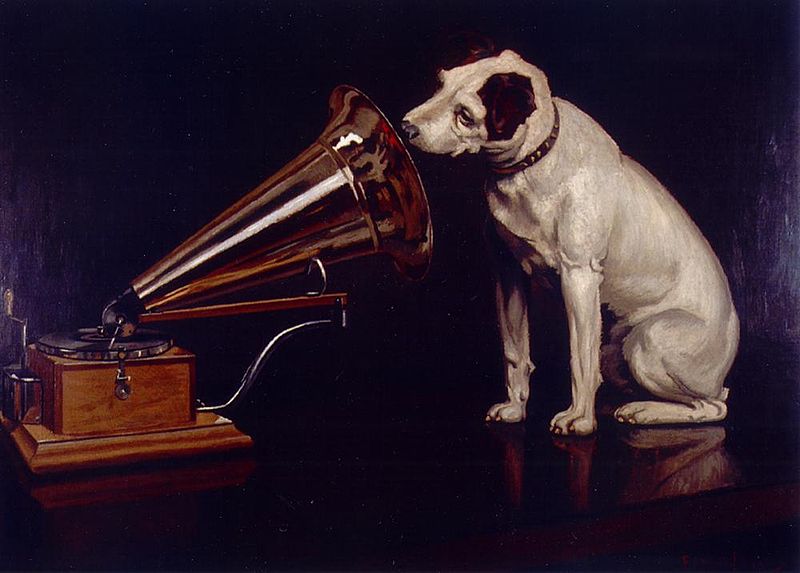
Milton’s guilty pleasure is The Turin Horse, possibly the last film by the Hungarian filmmaker, Béla Tarr.  It’s shot in black and white, it runs 146 minutes with minimal action, and the little dialogue that is spoken is in Hungarian.  My boss, Elsbeth, who is of Hungarian descent, wanted to get a ticket, too, but when she revealed this to me I discovered that it was already sold out.  As fate would have it, the FSLC has posted the trailer online and voila!  Tickets are suddenly available again.  I cocked my head like Nipper the RCA dog and thought:

Me:  Huh!  How’d that happen?

Painting of Nipper allegedly listening to the sound of his master's voice, but it could have also been a recording of the cat next door.

Then, I watched the 45 second trailer.  I urge all Lame Adventures readers to do so now:

Hm, I wonder if there might have been an onslaught of returns and Milton and I will have the theater all to ourselves?  I’m debating whether or not to tell my superior that tickets are available again.  I could sorely use a raise but I’m unsure if passing on this news will grant me one or get me fired.

Lame Adventure 234: My Crack

When I was young, it was easy for me to equate theater, particularly Broadway shows, as the domain of rich oldsters and out-of-towners with money to burn.  Most years, I had seen one or two plays on or Off-Broadway, but theater was seldom on my radar.  Even when peers raved about shows they’d seen, I’d stifle a yawn and calculate in my head how many films I could catch for what they shelled out for tickets. I once met a Tony-award winning Broadway producer who took me out to breakfast and urged me to write a play.  I thought:

Me:  I’d rather split an atom in my kitchen.

Then, something happened in this millennium.  Although I’ve never been rich, as I grew less young I had an itch to slightly expand my mind entertainment-wise. Theater began to catch my attention.  Often as I was reading theater reviews while puffing on my Sherlock Holmes pipe I’d think:

Me:  Hm that sounds interesting.

Once I made the escape from working mega-hours in network news to my current get-rich-slow career, Minister of Tile Labeling (an industry that Coco claims has the capacity to age the face faster than vodka), I had the time to make plans after work and on weekends.  During the brief period before the economy capsized when I was paid a salary that resembled a living wage, I could indulge theatergoing with Milton to my heart’s content.  Since my pay was slashed 20% nearly three years ago, I have had to make some tough financial decisions in order to feed my inner theatergoing beast.  Yet, I know that my life will have entered freefall when I can no longer find a way to see the latest Stephen Sondheim revival or catch the transition from Off-Broadway to Broadway of one of the hottest new plays – the erotically charged Venus in Fur starring Nina Arianda (who originated the role of Vanda in the production staged at CSC in 2009), and Hugh Dancy.

Arianda and Hugh - hot couple, hot ticket.

Milton was particularly thrilled with the addition of Hugh to the cast.

Milton:  I’d see him play a tree!

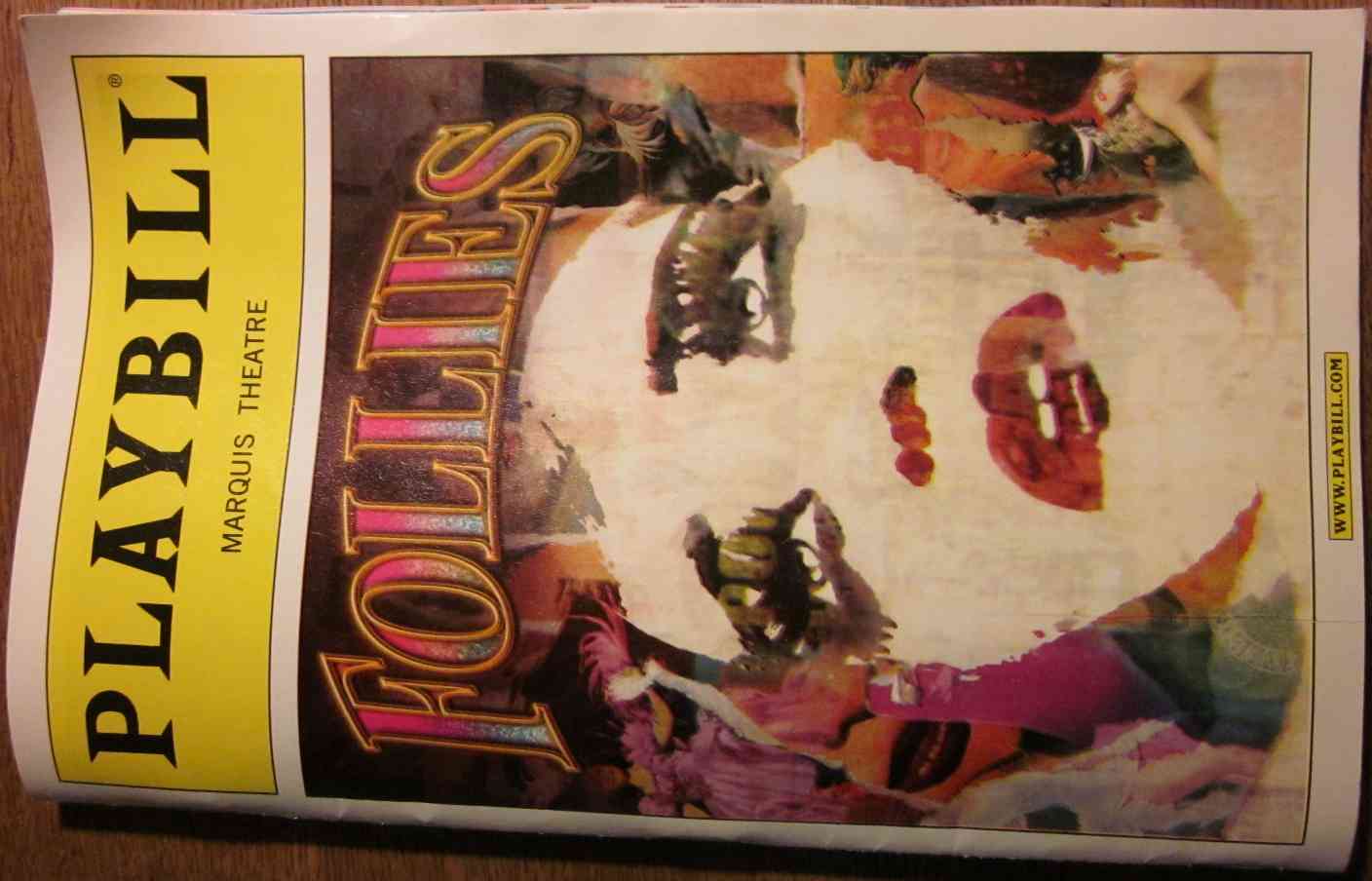
Due to my ongoing financial limitations, Milton and I attend far fewer Broadway shows now but he did score us deeply discounted tickets to see that latest Sondheim revival, the lavishly produced, Follies, starring Bernadette Peters and Jan Maxwell.  They play long retired showgirls from a bygone era that reunite shortly before the theater of their youth is razed to make room for a parking lot.

That description leaves a helluva lot out including thirty years of disappointment, disillusion, infidelity, suffering, humiliation and that treasured chestnut, rejection.  All of these emotions are illustrated with powerful singing, excellent dancing and it’s haunted with ghosts.  What’s not to love when a show this complex and elaborate is as beautifully staged as this revival?

One thing that immediately comes to my mind is the 50-year-old mama’s boy sitting next to me with his date (yes, his mother).  He mimicked the entire score from start to finish with a low, off-key hum, that I initially thought was either a new breed of mosquito buzzing outside my ear canal or I was channeling someone’s prolonged death rattle.  Yet, even that unanticipated annoyance was incapable of destroying the brilliance of Sondheim’s inventive lyrics, but had I access to a polo mallet, a large sock filled with crushed brick, or simply a baseball bat, it is possible I would have ignored my inner pacifist and smashed Sonny’s head.

Afterward, Milton announced that Follies “was good,” but then his face contorted slightly into the Milton-wince, my cue to ask:

Me:  What was your problem with it?

Milton:  Anything Goes has raised the bar too high.  This wasn’t at that level, so I was a little disappointed.

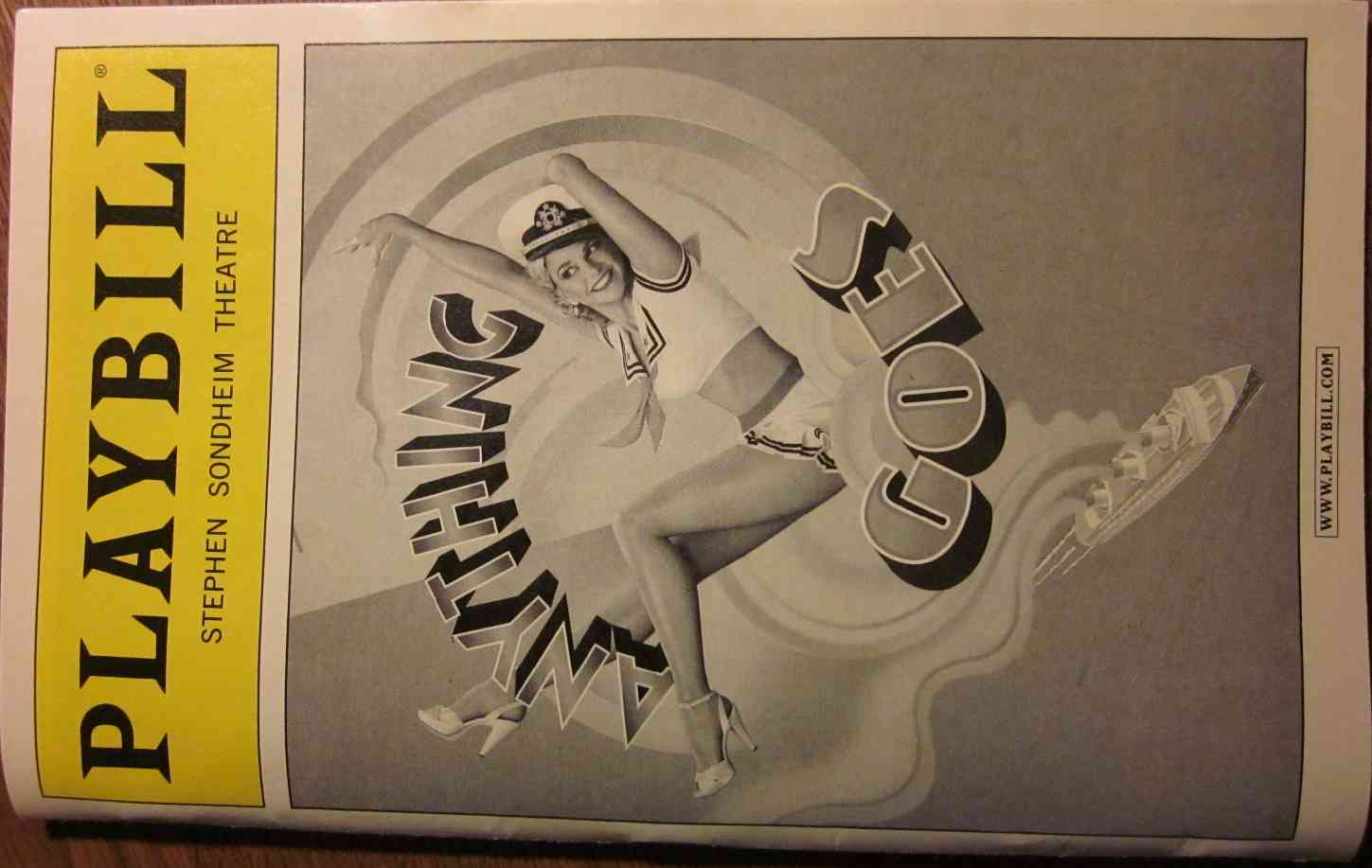
B&W playbill for very colorful show.

Last July, Milton and I scored 2 for 1 third row aisle Orchestra seats to this madcap Tony-award winning music comedy revival.  It’s a Cole Porter masterpiece starring the reigning queen of Broadway, Sutton Foster play nightclub singer, Reno Sweeney.  To put it in perspective about how terrific Anything Goes is, due to the boneheaded mistake of eating a single hot wing prior to curtain, I suffered near-debilitating heartburn apparently for the entirety of the first act.  I say “apparently” because I was so completely captivated by the book, the elaborate choreography, spot-on singing and Sutton’s megawatt charisma, I did not realize until intermission that my feel sharp chest pain had escalated and it was possible that I was actually suffering a massive heart attack instead.  Had I bought my rainbow while watching that show, I would have exited this life in toe-tapping bliss.   Fortunately, a single hot wing is not lethal.  I recovered during the second act that was as wonderful as the first.  For me, this show was as healing as a visit to Lourdes.  Theater is that wonderful.

Collin Donnell, Anything Goes leading man outside stage door -- photographed by eagle-eyed Milton.

Lame Adventure 233: We means you

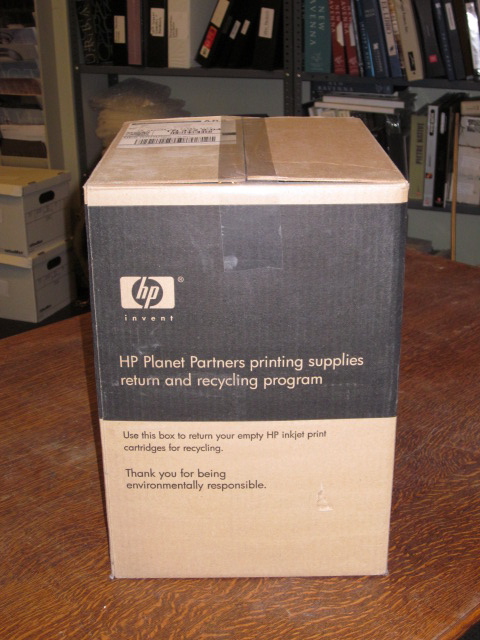
On a Monday in July 2007, the halcyon days of the economy when I was paid significantly better — before my wages were radically reduced in 2009 and have remained as frozen as a dead polar bear in the Arctic ever since, my boss, Elsbeth, arrived at work carrying a flat HP Planet Partners Return and Recycling box.  This box was for her used home printer cartridges.  She was feeling very proud of herself for being environmentally responsible.

Elsbeth:  When we fill up this box, we ship it back to HP – postage paid!

Me (placating tone):  Okay, we’ll do that.

I knew that the we she was referring to was actually me.  My lord and master proceeded to assemble the box.

Elsbeth's empty box.

She then placed it in the warehouse outside our office where I proceeded to forgot about it.

Me (thinking):  It’ll take her a hundred years to fill that box!  Ha!  There’s some schmuck or schmuck-ette out there right now that’ll be stuck shipping it back.  Loser!

Fast-forward four years, two months and 84 cartridges later …  On a recent Thursday Elsbeth enters our office, excited.

Elsbeth:  My box is full!  We have to return it!

The night before, I had been up until 5 am writing.  Therefore, I was not at my most coherent.  In fact, I seem to recall being 90% asleep.  I slap myself in the face and hack a hairball.

Me (thinking):  Where’d that come from?

Me (saying):  Huh?  What box?

Elsbeth:  My printer cartridge box!  It’s filled up!  We have to return it!

Me (zero enthusiasm for I know this means I have to move my exhausted carcass):  I’ll deal with it.

I sleepwalk out of our office into the warehouse where I take the box.  I notice that mid-way over the course of the four years and two months that my liege was depositing her spent cartridges into the box her aim ran off course and she was dumping them around the inner plastic bag rather than in it.  Although I could easily say:

Me (easily saying):  Screw this.

And then seal the box as is, the lapsed Catholic in me knows that’s wrong.  Sighing so loudly, the flock of pigeons perched outside the windowsill takes flight; I proceed to repack all the cartridges.

84 spent HP printer cartridges.

Siamese twin adhered yellow and magenta cartridges that apparently brought out the mad scientist in my boss.

Yet, I suppose things could be worse, I could be unemployed or I could be my friend, Coco, who the next day encountered, in the middle of our luxury showroom floor, a customer that breast-fed a toddler that was so large, this kid could easily try out to play on the Knicks – whenever basketball season gets underway again.  I know I’d much rather repack a box while suffering a coma than have that site shoved in my face.

Sealed repacked box good to go home to HP.

Lame Adventure 232: Papering the House

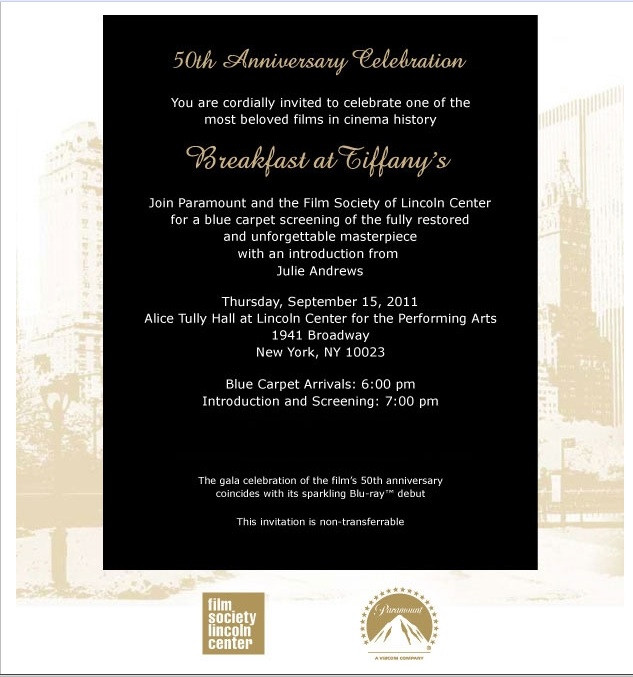
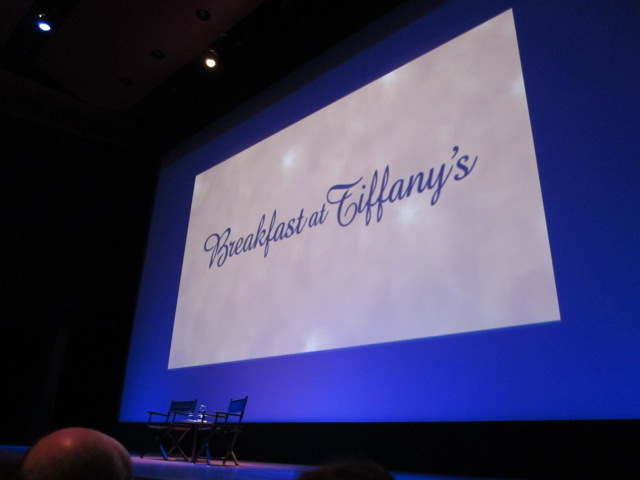
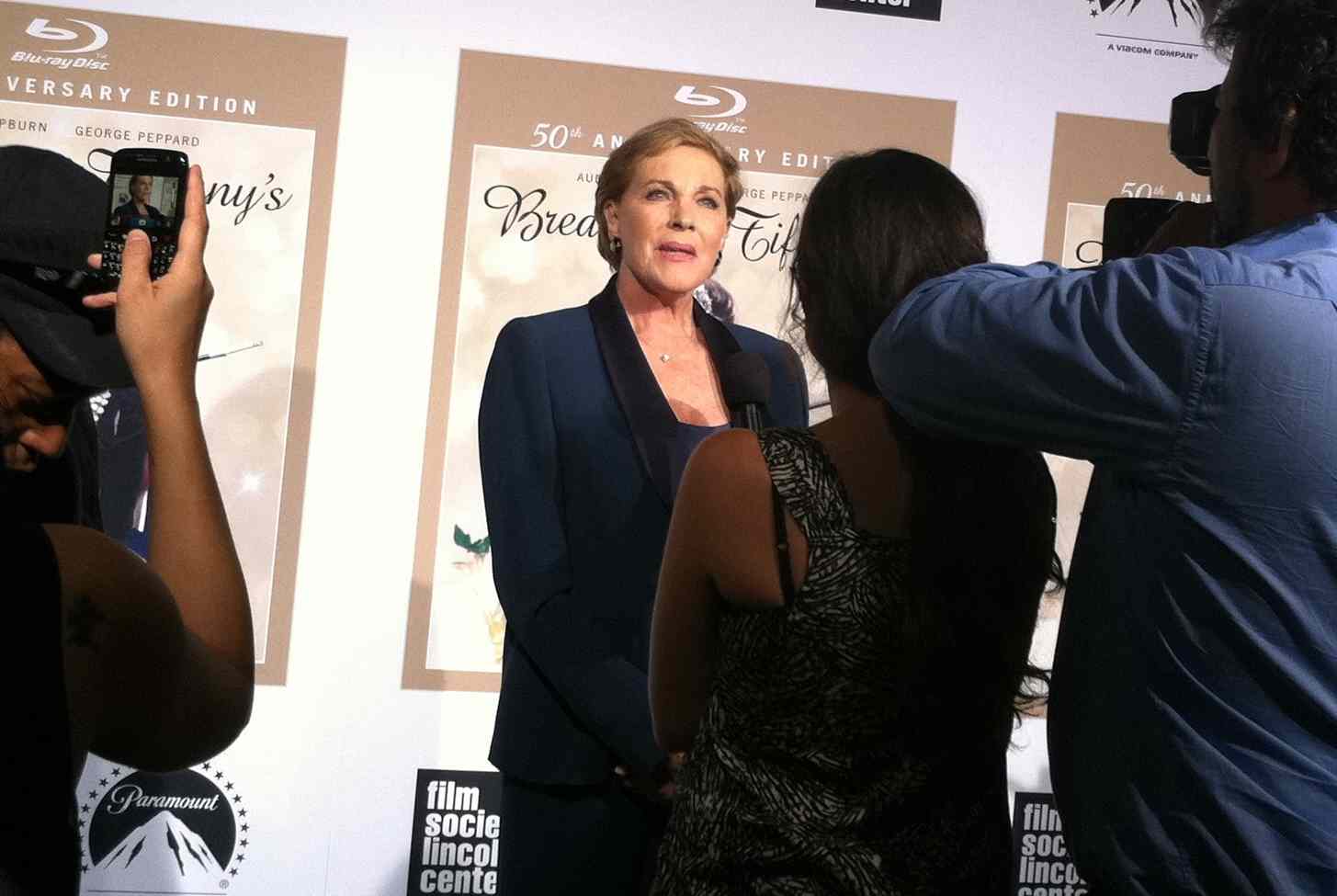
Last week Milton scored an invitation for two to the Film Society of Lincoln Center’s blue carpet 50th anniversary celebration of Breakfast at Tiffany’sThe film is also being released on Blu-ray DVD.

We want you, Milton!

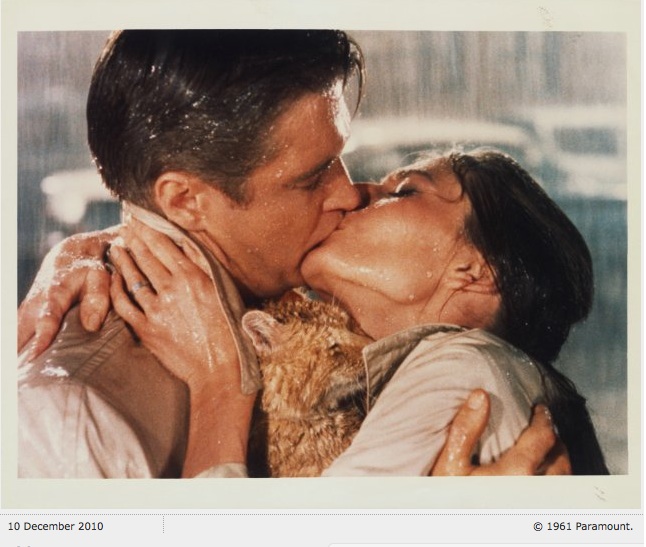
This Hollywood classic stars Audrey Hepburn as Holly Golightly, in her most iconic role, a free-spirit that accepts $50 from gentlemen admirers for powder room visits; George Peppard, as Paul Varjak, a struggling writer with perfect hair; and Patricia Neal, as 2E, Paul’s cougar sugar-mama.  2E does not exist in author Truman Capote‘s original novella, nor is the writer named Paul Varjak and he actually works a crummy day job, something the filmmakers must have considered too tragic to show on the silver screen.

Perfect Hair George frame left, Audrey Hepburn center, Patricia Neal frame right.

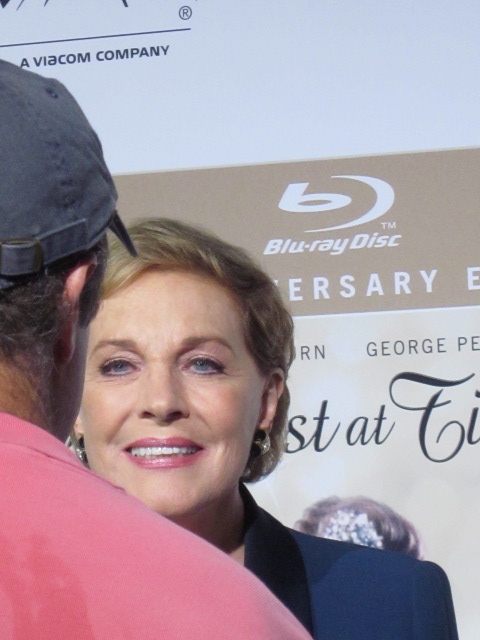
Screen legend in her own right, Julie Andrews, the widow of the film’s director, Blake Edwards, was enlisted to walk the blue carpet en route to delivering an introduction before the screening of the beautifully restored print at Alice Tulley Hall in Lincoln Center.

Even though other attendees paid for their seats, since the screening was not sold out, the FSLC emailed members that they could have a pair of tickets for free on a first come, first serve basis.  Milton said we were being tagged to paper the house.

Milton:  Do you want to go?

Me:  From now on call me Boise-Cascade!

Precious ducat.

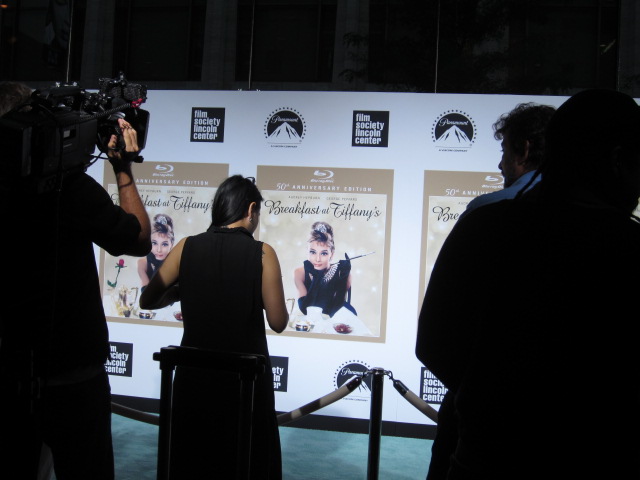
Press and photographers crowded the space in front of the blue carpet making it tough for onlookers like us to see much behind a barricade. One of a cluster of women of a certain age who very likely first saw the film when it was initially released in 1961 opined about the blue carpet:

Woman of a Certain Age:  That’s the blue carpet?  It looks more like a bathroom rug.

Crappy blue carpet.

Milton and I agreed that she had the right idea.

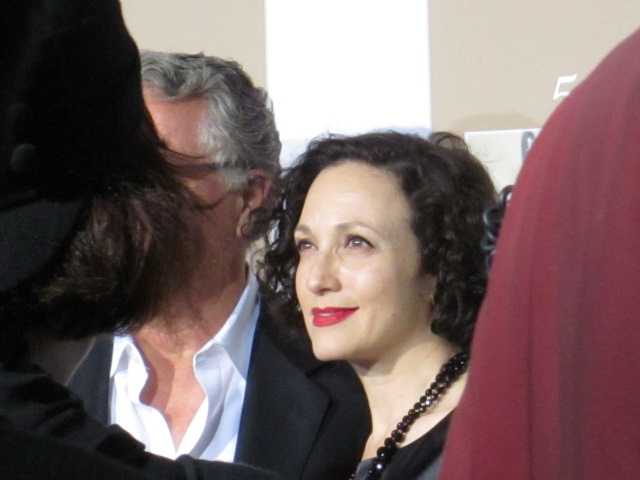
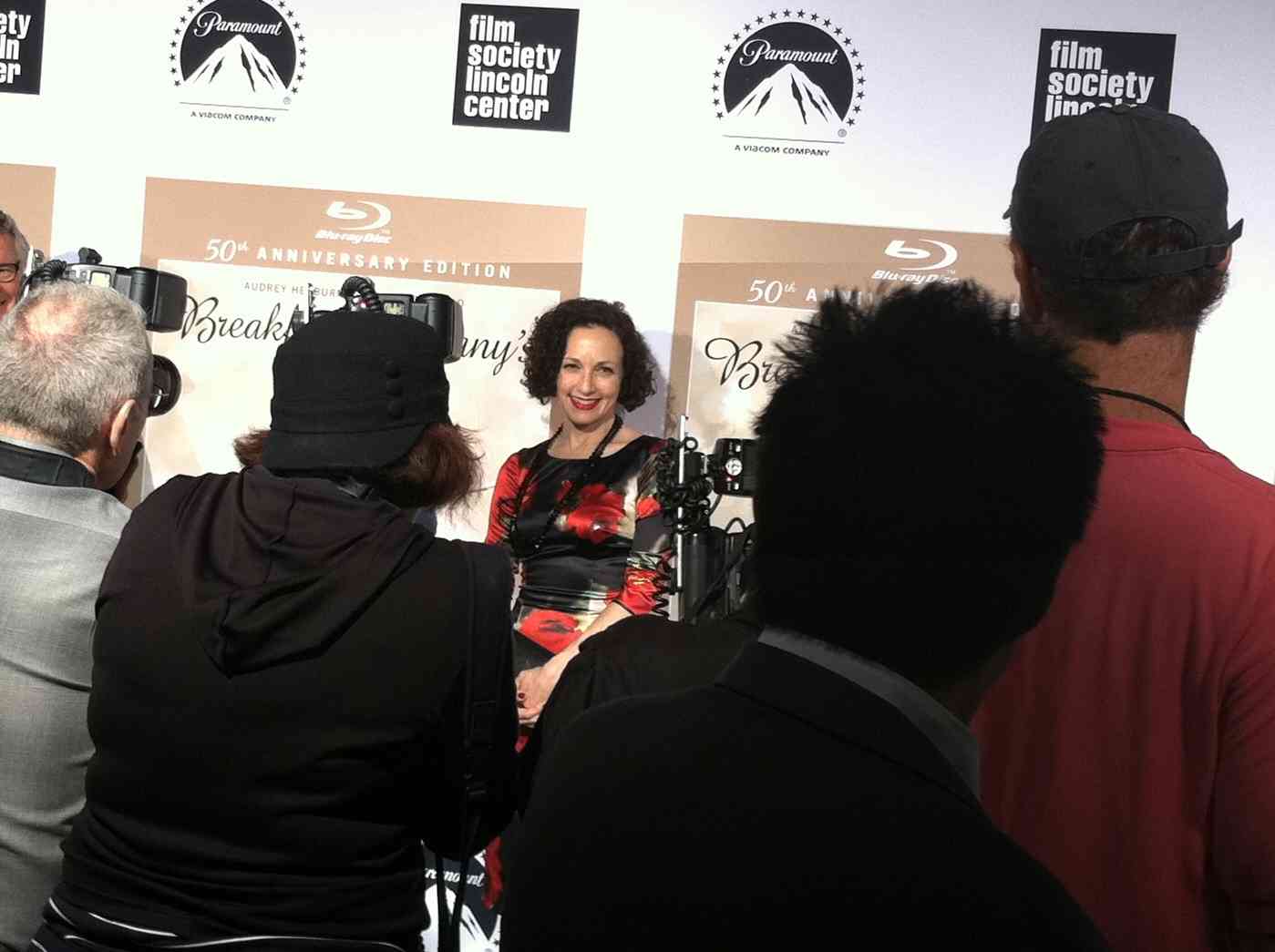
A celebrity arrived, actress Bebe Neuwirth and her husband, Chris Calkins.

Bebe Neuwirth with her husband Chris Calkins of the Obscured Face.

The women of a certain age banter amongst each other.

Woman of a Certain Age:  Who is that?  Is that Rachel’s daughter?

Me (thinking):  Who the hell’s Rachel?  That’s Bebe Neuwirth.

Another Woman of a Certain Age:  I think that’s Bebe Neuwirth.

Woman of a Certain Age (who thought Bebe was Rachel’s daughter):  How old is she now?

Another Woman of a Certain Age:  Who?

Woman of a Certain Age:  This Bebe Neuwirth we’re looking at.  What is she, 60?  Do you like how she looks?

I want to scream, but I’m mute.  For the record, Bebe’s 52.  Milton and I thought she looked great.

Press swarming Bebe.

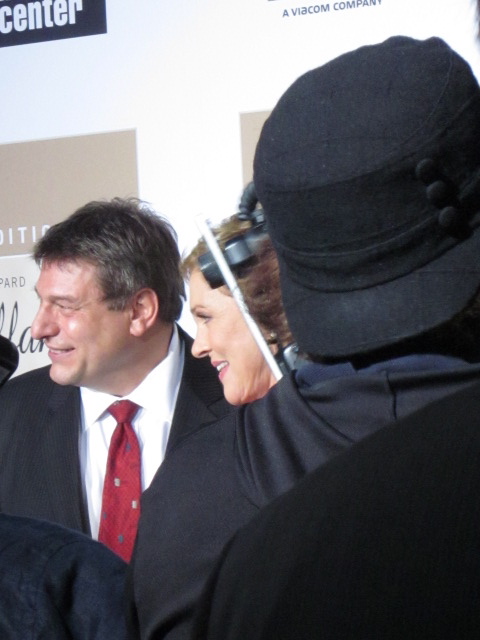
There’s a roar to our left.  For a flash Milton and I think that Holly Golightly has arrived, but it’s second best, Julie Andrews is in the house!  She looks radiant wearing a blue tuxedo, which should have been the shade of the carpet.

Milton times this shot of Juiie Andrews perfectly.

Milton is on a tear taking pictures with his iPhone, but he presses the wrong button and he starts photographing himself beneath the chin, so we have a selection of shots of his goatee at an odd angle.

I am not allowed to post any of those images.

Fortunately, we get a few decent shots, so decent that a woman of a certain age declares:

Woman of a Certain Age:  You finally got a good one!

My good shot of Julie Andrews. Finally.

Once Julie, who takes her time talking to members of the press and posing for photographs moves on, a blonde enters.

Mystery "Who cares?" Woman.

Me:  Who’s that?

Milton: Probably a real housewife of Lincoln Square.

A cameraman starts filming us.

Filming us. We return the compliment.

We lower our cameras and head into the theater.

After I take this shot a guard approaches me:

Inside the theater.

Guard:  There’s no photography in the theater.

I pack my camera away, but when Julie takes the stage with the FSLC program Director, Richard Peña, it seems like every iPhone in the joint is whipped out.

Julie Andrews and Richard Peña moments earlier on the crappy blue carpet.

I could easily breakout my camera again, but instead, I breakout a ham sandwich.  It’s late and I’m hungry.

Julie and Peña conduct an easy exchange about the film.  She was appearing on Broadway when she first saw it on her day off in 1961 at Radio City Music Hall.

Julie:  I never dreamed that the director would be my husband.

This makes sense since she would remain married to designer Tony Walton for another six years.

She speaks warmly about Audrey Hepburn, who became a close friend of hers, and says that Blake Edwards adored her, too:

Julie:  She might have been my competition!

She speaks about the memorable party sequence and says that Blake:

Julie: Cast his friends and everyone he knew.

After praising the contribution of Hubert de Givenchy’s wardrobe, Julie announces:

Julie: When you’ve got Audrey Hepburn and Hubert de Givenchy, I don’t think anyone for a second believed that this was a heavy hooker, for God’s sake.

This is true, the screenplay that George Axelrod loosely adapted from Capote’s  novella takes many liberties with the author’s beautifully crafted World War II era story; a much grittier and poignant tale that I recently read again.  Capote wanted Marilyn Monroe cast in the role of Holly, an excellent choice, but she turned down the part because she was advised that playing a woman of questionable repute would not be good for her image.  Milton thinks that had Marilyn played the part instead of Audrey, she would have won an Academy Award.  Also, happily ever after romance lovers, although this harder, colder creature is recognizably Holly, and the writer-narrator is both fascinated and smitten with her, they’re just platonic friends.  Holly is from start to finish “a wild thing” — untameable, independent and mysterious.  She also eludes to being bisexual, something else excluded from the script.

Milton wonders if Capote was livid about the boatload of changes made to the source material to make it the crowd-pleaser it’s been for fifty years.  He deems this film is a precursor to another highly successful and completely implausible fairy tale romance, Pretty Woman.  I reason that back in 1961, there was no way that this novella’s darker open-ended tale could have been adapted.  Yet,  the audience at this anniversary screening seemed to be watching in a state of bliss.   What brings out the sap in me about this film is the Academy Award winning Henry Mancini score and the song Moon River with lyrics by Johnny Mercer.   That catchy song has been playing on a loop inside my head for a solid week.  Every time I come across the lyric “my Huckleberry friend” I’m stumped.  What the hell is that?  The Urban Dictionary has two answers:

1. A very special, good friend that’s been in your life for years, typically since youth.

2. A fuck buddy.

Outside the theater, following the screening Milton and I are a safe distance from the adoring masses.  He voices a unique observation about this film that surely would have gotten both of us killed if said inside:

Milton:  Just because something’s classic doesn’t mean it’s good.

Fifty years later, we’d like to suggest the unthinkable – not a remake, but a version of Breakfast at Tiffany’s that is true to Capote’s original novella.  Todd Haynes, if you’re wondering what to work on next, how about giving this a try?

Source material.

Milton and I noticed that the one character that perfectly made the transition from novella to screen was Holly’s “poor slob without a name” cat played by Orangey.  He certainly made the most of his close-ups.

Orangey as Cat center frame.